AMD EPYC Embedded 8004: Zen 4c Powers Edge Computing
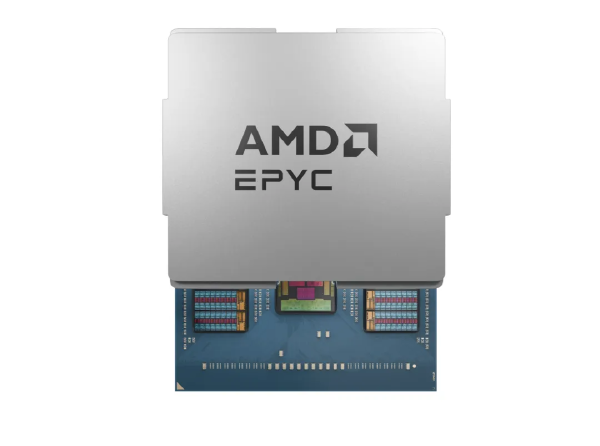
AMD has expanded its embedded processor lineup with the EPYC Embedded 8004 Series, marking the debut of the Zen 4c architecture in the embedded space. Unlike traditional server CPUs that prioritize peak performance, this lineup is engineered for efficiency, density, and thermal constraints.
Target applications include networking systems, security appliances, industrial edge computing, and compact infrastructure where space, power, and cooling are limited.
🧩 Zen 4c: A Density-Optimized Architecture #
The defining innovation of the EPYC Embedded 8004 series is the Zen 4c core, a variant of Zen 4 designed specifically for high-density deployments.
Key Characteristics #
-
Smaller core footprint
- Approximately 19% reduced die area compared to standard Zen 4
- Enables significantly higher core density within the same package
-
Efficiency-focused design
- Lower operating frequencies
- Optimized power consumption for sustained workloads
-
Cache trade-offs
- Up to 3× less L3 cache than Zen 4
- Prioritizes parallel throughput over cache-heavy workloads
This design reflects a shift toward throughput-per-watt optimization, ideal for highly parallel edge and networking tasks.
📊 EPYC Embedded 8004 Series Specifications #
The 8004 series is built for single-socket platforms and supports:
- 6-channel DDR5 memory
- Up to 1.152TB memory capacity
- High I/O flexibility for embedded deployments
SKU Overview #
| Model | Cores/Threads | Base/Boost Clock | L3 Cache | TDP |
|---|---|---|---|---|
| EPYC 8534P | 64C / 128T | 2.3 / 3.1 GHz | 128MB | 200W |
| EPYC 8434P | 48C / 96T | 2.5 / 3.1 GHz | 128MB | 200W |
| EPYC 8324P | 32C / 64T | 2.65 / 3.0 GHz | 128MB | 180W |
| EPYC 8224P | 24C / 48T | 2.55 / 3.0 GHz | 64MB | 180W |
| EPYC 8124P | 16C / 32T | 2.45 / 3.0 GHz | 64MB | 125W |
| EPYC 8C24P | 12C / 24T | 2.45 / 3.0 GHz | 32MB | 100W |
⚖️ Positioning vs. EPYC 9004 (Zen 4) #
The EPYC Embedded 8004 series is not intended to replace the high-end EPYC 9004 (Zen 4) lineup. Instead, it serves as a specialized alternative for constrained environments.
Platform Differences #
-
PCIe lanes
- 8004: 96 lanes (PCIe 5.0)
- 9004: Up to 128 lanes
-
Memory channels
- 8004: 6 channels
- 9004: 12 channels
-
Thermal profile
- 8004: Up to 225W TDP (configurable down to ~70W)
- 9004: Up to 360W TDP
-
Form factor advantage
- Smaller footprint enables compact motherboard designs
- Ideal for dense, space-constrained deployments
This makes the 8004 series better suited for efficient scaling, rather than maximum raw performance.
🌐 Target Workloads and Use Cases #
AMD is positioning the 8004 series for scenarios where parallel processing efficiency and thermal limits are critical.
Networking and Telco #
- Virtualized firewalls
- High-throughput routing
- Network function virtualization (NFV)
Industrial Edge Computing #
- Real-time processing of sensor data
- Factory automation and control systems
- Edge analytics with limited cooling
Micro Data Centers #
- Localized cloud services
- Edge caching and content delivery
- Environments with strict power and space constraints
These use cases benefit more from core density and efficiency than peak clock speeds.
🔮 Final Take: Right-Sized Compute for the Edge #
The EPYC Embedded 8004 series reflects a broader industry shift toward right-sized computing.
Instead of maximizing raw performance, AMD focuses on:
- Higher core density
- Improved performance-per-watt
- Scalability within constrained environments
By leveraging Zen 4c, AMD delivers a platform tailored for the growing demands of edge infrastructure, industrial systems, and network workloads.
As computing continues to decentralize, architectures like Zen 4c are likely to play a central role in shaping the next generation of distributed systems.