Apple Reportedly Chooses Intel 18A-P for Future M7 Chips
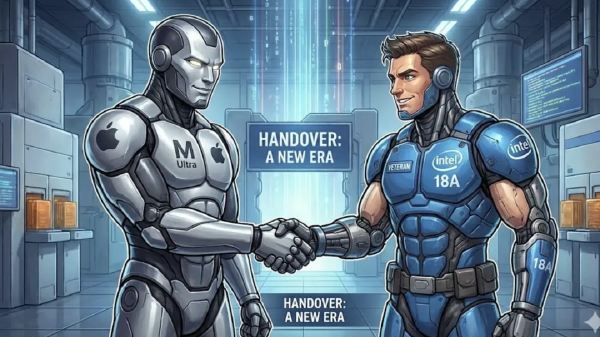
Apple may soon diversify its semiconductor manufacturing strategy beyond TSMC. According to industry reports, Apple and Intel signed a preliminary manufacturing agreement in late 2025 that could bring future Apple Silicon chips onto Intel’s advanced process nodes.
Under the reported plan:
- The Apple M7 chip is expected to use Intel 18A-P technology with mass production targeted for late 2027.
- Future A21 iPhone processors may transition to Intel 14A around late 2028.
If realized, this would represent one of the most significant strategic shifts in Apple’s semiconductor roadmap since the launch of Apple Silicon.
🏭 Apple Moves Beyond Exclusive TSMC Dependence #
For years, Apple relied almost entirely on TSMC for advanced-node manufacturing, including:
- N3
- N3E
- Subsequent node refinements
However, the AI boom is dramatically changing semiconductor supply dynamics.
AI Demand Is Consuming Advanced Capacity #
The rapid expansion of AI infrastructure has created unprecedented demand for:
- Advanced wafers
- CoWoS packaging
- HBM memory integration
- High-end accelerator production
As a result, more manufacturing resources are being allocated toward AI GPUs and datacenter accelerators instead of consumer SoCs.
Why Apple Is Concerned #
Apple ships massive volumes of iPhone and Mac processors every year.
This makes the company extremely sensitive to:
- Wafer availability
- Yield stability
- Packaging capacity
- Production scheduling
Even with Apple’s historically privileged position at TSMC, maintaining guaranteed leading-edge capacity has become increasingly difficult in the AI era.
For Apple, supply chain diversification is now becoming a strategic necessity rather than merely a cost optimization exercise.
⚙️ Why Apple May Choose Intel 18A-P #
Apple’s reported selection of Intel 18A-P suggests the partnership is intended for serious production rather than symbolic cooperation.
Intel 18A-P Overview #
18A-P is expected to focus on:
- Higher performance
- Improved power efficiency
- Better voltage stability
- More aggressive power curve optimization
This aligns closely with Apple’s priorities for Mac-oriented SoCs.
Why It Fits the M-Series #
Apple Silicon designs emphasize:
- Large cache architectures
- Wide memory bandwidth
- Low power consumption
- Sustained efficiency under heavy workloads
For these designs, transistor leakage control and low-voltage efficiency are often more important than peak clock frequency.
That makes 18A-P potentially attractive for future M-series processors used in MacBook systems.
🔬 Intel 14A Targets Future iPhone AI Workloads #
The reported roadmap also indicates Apple may adopt Intel 14A for future iPhone chips.
Key Technologies Inside 14A #
Intel 14A is expected to further advance:
- RibbonFET gate-all-around transistor technology
- PowerVia backside power delivery
- High-NA EUV lithography
Why This Matters for Mobile AI #
Modern A-series processors increasingly allocate silicon area toward:
- Neural processing units (NPUs)
- On-device AI acceleration
- Local inference workloads
Traditional CPU frequency scaling is no longer sufficient to manage performance-per-watt requirements.
14A could help Apple improve:
- AI efficiency
- Thermal density
- Battery life
- Power delivery stability
These factors are becoming increasingly important as on-device AI workloads continue expanding.
🇺🇸 The Growing Importance of “Made in USA” Semiconductors #
Geopolitical considerations are also likely influencing Apple’s strategy.
U.S. Semiconductor Policy Alignment #
The U.S. government has strongly promoted domestic semiconductor manufacturing through:
- CHIPS Act funding
- Subsidies
- Strategic manufacturing initiatives
Intel has become a central pillar of America’s advanced manufacturing ambitions.
By moving some Apple Silicon production to Intel fabs in the United States, Apple would align itself more closely with national semiconductor policy goals.
Supply Chain Resilience #
Domestic manufacturing could also help Apple reduce exposure to:
- Regional geopolitical risks
- Overseas supply disruptions
- Concentrated manufacturing dependencies
For a company operating at Apple’s scale, geographic diversification has become increasingly important.
📈 Why Apple Is So Important for Intel Foundry #
For Intel, winning Apple business would carry enormous strategic value beyond direct revenue.
Apple Represents Industry Validation #
Apple is widely regarded as one of the semiconductor industry’s most demanding customers.
Its requirements for:
- Yield consistency
- Power efficiency
- Packaging quality
- Long-term reliability
- Volume scalability
are among the strictest in the world.
If Intel successfully enters the Apple Silicon supply chain, it would effectively validate Intel Foundry as a credible leading-edge manufacturer for other large customers.
A Similar Model to TSMC #
Interestingly, Intel would simultaneously:
- Manufacture chips for Apple
- Compete against Apple devices with its own PC platforms
This mirrors TSMC’s relationship with companies such as AMD and NVIDIA, where foundry operations and end-product competition remain separate business layers.
⚠️ Major Challenges Still Remain #
Despite the strategic significance of the reported agreement, several major technical and operational challenges remain unresolved.
Critical Questions Facing Intel #
Can 18A-P and 14A Reach Stable Volume Production? #
Advanced nodes are extraordinarily difficult to ramp successfully at scale.
Intel must demonstrate:
- Stable process maturity
- Consistent yields
- Predictable manufacturing timelines
Can RibbonFET and PowerVia Scale Properly? #
Both technologies are fundamental to Intel’s future roadmap.
Apple’s massive shipment volumes would place extreme pressure on:
- Yield rates
- Defect density
- Packaging stability
Can Intel Balance Internal and External Demand? #
Intel must support:
- Its own CPU and GPU roadmaps
- Foundry customers
- AI packaging demand
- Advanced-node allocation
Balancing these priorities will be operationally complex.
✅ Conclusion #
Apple’s reported move toward Intel Foundry could reshape the semiconductor landscape over the next several years.
By potentially adopting:
- Intel 18A-P for future M-series processors
- Intel 14A for future A-series chips
Apple would gain additional supply chain flexibility while helping validate Intel’s advanced manufacturing ambitions.
For Intel, securing Apple as a foundry customer would represent a major credibility milestone in its effort to become a world-class contract manufacturer once again.
Whether this partnership reaches full-scale production will depend on Intel’s ability to deliver stable yields, advanced packaging maturity, and reliable manufacturing capacity on schedule.