Intel Nova Lake Brings Back AVX-512 as 14A2 and Arc GPU Updates Advance
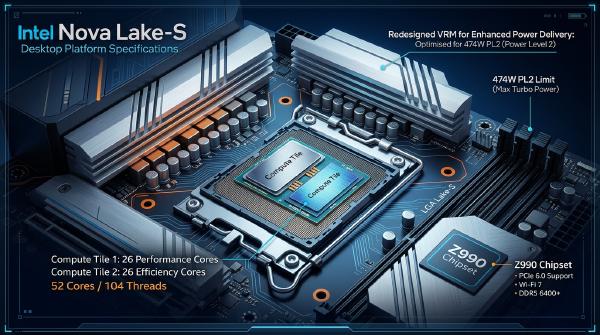
Intel is preparing a series of major hardware and software advancements that span processor architecture, semiconductor manufacturing, graphics software, and product pricing. The company’s upcoming Nova Lake (Core Ultra Series 4) processors will reintroduce AVX-512 support through the new AVX10.2 architecture, while its next-generation 14A2 process node aims to strengthen Intel Foundry’s position against TSMC and Samsung.
Meanwhile, Intel’s Linux graphics ecosystem continues to improve with restored Vulkan Video encoding support for Arc GPUs, even as the company adjusts processor pricing in response to changing market conditions and supply chain costs.
🚀 AVX-512 Returns Through AVX10.2 #
One of the most significant architectural changes arriving with Nova Lake is the return of AVX-512, Intel’s advanced SIMD instruction set designed for highly parallel workloads.
Recent Linux kernel patches confirm that AVX-512 support is once again planned for Intel’s consumer processors after several generations of absence.
AVX-512 enables processors to execute 512-bit vector operations in a single instruction, accelerating workloads such as:
- Scientific computing
- Engineering simulations
- Cryptography
- Data compression
- Image and video processing
- AI inference
- High-performance computing
The instruction set last appeared in Intel’s consumer lineup with Tiger Lake and Rocket Lake processors before disappearing in subsequent hybrid architectures.
Why AVX-512 Was Removed #
Beginning with Alder Lake, Intel introduced its hybrid CPU architecture featuring:
- Performance cores (P-cores)
- Efficiency cores (E-cores)
While the P-cores supported AVX-512 internally, the first-generation E-cores lacked compatible execution hardware.
If an operating system migrated an AVX-512 workload from a P-core to an E-core, the mismatch could produce incorrect execution or software instability.
Rather than allowing inconsistent instruction support, Intel disabled AVX-512 entirely across its consumer product line.
AVX10.2 Solves the Compatibility Problem #
Nova Lake addresses this limitation through AVX10.2.
The updated instruction set requires feature parity across different CPU core types.
Both:
- Coyote Cove P-cores
- Arctic Wolf E-cores
will implement compatible AVX10.2 functionality, allowing the operating system scheduler to move threads freely without encountering instruction incompatibilities.
This unified architecture restores advanced vector processing while preserving the flexibility of Intel’s hybrid core design.
Performance Potential #
Vectorized workloads can benefit significantly from AVX-512 acceleration.
Comparable implementations have demonstrated substantial performance improvements in applications optimized for wide-vector execution, including scientific simulations, media encoding, and AI inference.
By restoring full vector support across every core, Intel narrows a competitive gap that has benefited processors supporting modern 512-bit vector execution in workstation and technical computing environments.
Improved Thermal Efficiency #
Earlier AVX-512 implementations, particularly on Rocket Lake desktop processors, were known for extremely high power consumption and thermal output under sustained vector workloads.
Nova Lake is expected to mitigate these issues through:
- More advanced semiconductor manufacturing
- Improved power management
- AVX10.2-aware frequency control
- Better workload scheduling
These changes should allow AVX-intensive applications to run more efficiently without the severe thermal spikes associated with previous generations.
⚙️ 14A2 Expands Intel’s Advanced Process Roadmap #
Supporting Nova Lake’s architectural ambitions is Intel’s next-generation manufacturing roadmap.
The processor family is expected to utilize Intel’s upcoming 14A process technology, with an enhanced derivative known as 14A2 already under development.
Building on Backside Power Delivery #
The base 14A process introduces Intel’s PowerDirect technology, which separates power routing from signal routing through a Backside Power Delivery Network (BSPDN).
Moving power distribution to the rear of the silicon die offers several advantages:
- Reduced routing congestion
- Improved transistor density
- Better power integrity
- Increased design flexibility
Dual-Side Power Delivery #
The planned 14A2 node extends this concept by introducing a dual-side power delivery architecture.
Rather than relying exclusively on backside routing, the design distributes electrical power through both:
- Backside power networks
- Selected front-side metal layers
This hybrid approach addresses challenges that emerge as interconnect dimensions continue shrinking.
Smaller Metal Pitch #
Intel also intends to reduce the minimum M0 interconnect pitch from approximately 28 nm on 14A to roughly 21 nm on 14A2.
Smaller metal spacing enables:
- Greater transistor density
- Improved High-NA EUV utilization
- Better silicon area efficiency
However, shrinking interconnects increases electrical resistance, making power delivery more difficult.
To compensate, Intel’s dual-side architecture balances current distribution across multiple routing layers, reducing voltage drop while maintaining stable operation.
Advanced Node Roadmap #
| Foundry | Process | Planned Production |
|---|---|---|
| Intel | 14A / 14A2 | Risk production expected before volume manufacturing |
| TSMC | A14 | Commercial rollout planned following risk production |
| Samsung | 1.4nm-class | Mass production targeted later in the decade |
The coming years will see all three manufacturers competing aggressively for leadership in the next generation of advanced semiconductor manufacturing.
🖥️ Vulkan Video Encoding Returns for Intel Arc GPUs #
Intel’s software ecosystem is also seeing meaningful improvements.
The open-source graphics community has restored hardware-accelerated H.264 and H.265 encoding through the Vulkan Video API for Intel Arc GPUs within the upcoming Mesa 26.2 graphics stack.
Earlier support had been disabled because of incomplete validation for newer Intel graphics architectures.
Community contributors subsequently completed additional development and testing, successfully enabling encoding functionality using Intel Arc desktop hardware.
For Linux users, the update provides:
- Native Vulkan-based hardware video encoding
- Lower software overhead
- Improved compatibility for modern multimedia applications
Development continues toward adding full AV1 encoding support in future Mesa releases.
💰 Intel Adjusts Processor Pricing #
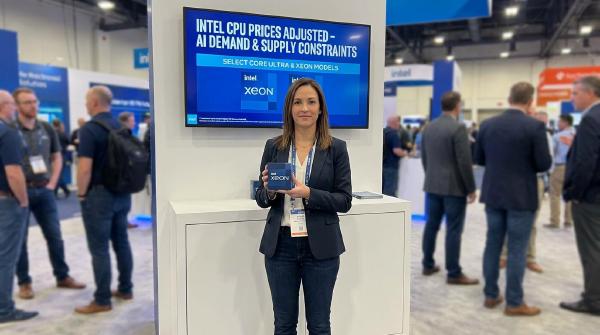
Alongside its technology roadmap, Intel has confirmed price increases affecting several desktop and server processor families.
The adjustments primarily impact:
- Core Ultra 200S Plus desktop processors
- Selected Xeon 6 platforms
- Xeon 8000 server processors
Examples include:
| Processor | Previous MSRP | Updated Retail Range |
|---|---|---|
| Core Ultra 7 270K Plus | $299 | $339–349 |
| Core Ultra 5 250K Plus | $199 | $219–229 |
| Core Ultra 5 250KF Plus | $184 | Approximately $214 |
Retail pricing has also begun adjusting across several international markets as distributors account for higher supply chain and operating costs.
📊 Outlook #
Intel’s latest announcements illustrate a company advancing on multiple fronts simultaneously.
Nova Lake restores one of the most requested instruction sets through AVX10.2, eliminating the compatibility issues introduced by earlier hybrid processor designs. At the manufacturing level, the planned 14A2 process pushes transistor scaling further with dual-side power delivery and tighter interconnect dimensions, reinforcing Intel’s ambitions in the advanced foundry market.
Combined with continued investment in open-source graphics software and broader product portfolio updates, these developments highlight Intel’s effort to strengthen both its hardware capabilities and software ecosystem as competition intensifies across AI, high-performance computing, and next-generation client platforms.