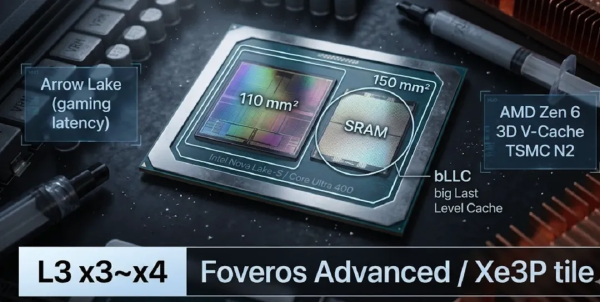
Intel Nova Lake Targets AMD Zen 6 With 52-Core Desktop CPUs
The x86 desktop processor market is approaching one of its most significant architectural transitions in years.
According to multiple upstream supply chain leaks, Intel has started distributing early engineering samples of its next-generation Core Ultra Series 4 desktop processors, codenamed Nova Lake-S, to major motherboard vendors for platform validation and firmware integration.
Expected to launch in the second half of 2026, Nova Lake represents Intel’s most aggressive desktop redesign since the introduction of hybrid architectures. The platform is being positioned directly against AMD’s upcoming Zen 6 “Olympic Ridge” processors, with Intel focusing heavily on multi-thread scaling, cache expansion, memory bandwidth, and high-performance AI-assisted workloads.
The headline specification is staggering: flagship Nova Lake desktop configurations are rumored to scale up to 52 cores, alongside an enormous on-die cache subsystem designed to challenge AMD’s dominance in gaming performance through 3D V-Cache technologies.
🚀 Nova Lake-S vs. Arrow Lake-S #
Nova Lake introduces a major redesign across nearly every critical subsystem compared to the current Arrow Lake generation.
| Feature | Arrow Lake-S | Nova Lake-S | Architectural Impact |
|---|---|---|---|
| Maximum Core Count | 24 Cores (8P + 16E) | Up to 52 Cores (16P + 32E + 4LPE) | Massive increase in parallel compute throughput |
| CPU Architecture | Lion Cove / Skymont | Coyote Cove / Arctic Wolf | Updated IPC and instruction pipeline optimizations |
| Maximum Cache | 36 MB L3 Cache | Up to 288 MB bLLC | Reduced memory latency and improved gaming performance |
| Socket Platform | LGA 1851 | LGA 1954 | Requires new Intel 900-series motherboards |
| Memory Support | DDR5 6400–7200 | DDR5 8000+ | Optimized for high-frequency CUDIMM memory |
| PCIe Connectivity | 24 PCIe 5.0 Lanes | 36 PCIe 5.0 Lanes (48 Total) | Expanded GPU and storage bandwidth |
| Power Envelope | 125W / ~250W Turbo | 175W / Up to ~700W MTP | Significant increase in transient power demands |
The architectural jump is not incremental. Intel appears to be redesigning the desktop platform around scalability and heterogeneous compute density rather than simply pushing higher clock frequencies.
🏗️ The Dual-Compute Tile Architecture #
The most important structural change in Nova Lake is Intel’s transition toward a scalable multi-tile compute design.
Instead of relying on a single monolithic compute die, flagship Nova Lake processors reportedly use two large compute tiles connected through a central SoC fabric.
Nova Lake-S Compute Tile Layout #
INTEL NOVA LAKE-S MULTI-TILE DESIGN

┌──────────────────────────────────────┐
│          COMPUTE TILE 0              │
│  8x Coyote Cove P-Cores              │
│  16x Arctic Wolf E-Cores             │
│  144 MB Big Last Level Cache         │
└──────────────────────────────────────┘

┌──────────────────────────────────────┐
│          COMPUTE TILE 1              │
│  8x Coyote Cove P-Cores              │
│  16x Arctic Wolf E-Cores             │
│  144 MB Big Last Level Cache         │
└──────────────────────────────────────┘

                │
                ▼

┌──────────────────────────────────────┐
│               SOC TILE               │
│  4x Low-Power Arctic Wolf E-Cores    │
│  Integrated NPU + Xe3 Graphics       │
└──────────────────────────────────────┘
This layout enables Intel to dramatically increase total thread throughput without creating a single oversized monolithic die that would become difficult to manufacture economically.
Core Scaling Across the Product Stack #
Not every Nova Lake processor will use the dual-tile layout.
According to current leaks:
- Entry-level and mainstream models will use single compute tiles
- Higher-end enthusiast SKUs will deploy dual compute tiles
- The flagship configuration combines:
- 16 Performance Cores
- 32 Efficiency Cores
- 4 Low-Power E-Cores
This results in a total of 52 cores, making Nova Lake one of the highest core-count mainstream desktop platforms ever introduced.
⚡ Intel’s Performance Ambitions #
Intel’s performance goals for Nova Lake appear highly aggressive.
Early validation data from motherboard partners suggests the company is targeting improvements in two key areas simultaneously:
- Higher per-core performance
- Dramatically improved multi-thread scaling
Single-Threaded Improvements #
Leaked engineering targets point toward approximately:
- 20% IPC uplift
- Improved AVX10.2 execution
- Expanded APX instruction optimizations
- Better branch prediction and scheduling efficiency
The updated Coyote Cove performance cores are expected to focus heavily on reducing instruction pipeline inefficiencies while improving AI-assisted compute acceleration.
Multi-Core Scaling #
The most dramatic gains come from raw parallelism.
Because flagship Nova Lake configurations nearly double the effective core count versus current Intel desktop processors, early projections suggest:
- 1.8x to 2.0x gains in heavily threaded workloads
- Significant acceleration for:
- Rendering
- Simulation
- Code compilation
- Local AI inference
- Content creation pipelines
If these projections hold, Nova Lake could become Intel’s strongest workstation-class desktop platform in years.
🎮 bLLC: Intel’s Counterattack Against 3D V-Cache #
One of Nova Lake’s most strategically important technologies is its rumored bLLC (Big Last Level Cache) architecture.
For several generations, AMD’s X3D processors dominated gaming benchmarks by dramatically increasing cache capacity through vertically stacked 3D V-Cache designs. These large cache pools significantly reduced memory latency penalties in gaming engines.
Intel now appears to be responding directly.
Massive Cache Capacities #
Current leaks indicate:
- Single-tile processors may include up to 144 MB of bLLC
- Dual-tile flagship variants could scale to 288 MB total cache
These capacities are unprecedented for Intel desktop CPUs.
Why Large Cache Matters #
Modern games and productivity workloads are increasingly sensitive to memory latency rather than pure clock speed alone.
A larger last-level cache allows the processor to retain:
- Game assets
- Simulation states
- AI inference tensors
- Render buffers
- Frequently accessed instruction data
closer to the compute cores, minimizing expensive trips to external DRAM.
Early motherboard validation reports suggest:
- 10–15% gaming performance improvements
- Smoother 1% low frame pacing
- Better responsiveness under mixed workloads
Unlike gaming-only cache optimizations, Intel is reportedly positioning bLLC as a broader acceleration layer for both gaming and professional workloads.
🔌 LGA 1954 and the New Power Reality #
Nova Lake’s massive compute density introduces equally massive platform requirements.
Intel’s upcoming 900-series motherboards, including high-end Z990 platforms, are reportedly undergoing major redesigns to support the new LGA 1954 socket ecosystem.
Extreme Power Delivery Requirements #
Flagship Nova Lake processors are rumored to operate at:
- 175W base TDP
- Up to 700W Maximum Turbo Power under transient spikes
Those numbers place unprecedented stress on motherboard power delivery systems.
As a result, board vendors are aggressively upgrading:
- VRM phase counts
- PCB layer density
- Cooling solutions
- EPS power delivery capacity
- Thermal dissipation systems
High-end enthusiast motherboards are effectively becoming workstation-class electrical platforms.
DDR5 8000 and Beyond #
Nova Lake also appears heavily optimized for next-generation high-frequency memory.
The platform is expected to support:
- CUDIMM memory
- CQDIMM signal optimization
- DDR5 frequencies beyond 8000 MT/s
- Experimental scaling toward 10,000 MT/s
These improvements rely heavily on onboard clock-driver technologies designed to improve signal integrity at extremely high transfer rates.
Memory bandwidth is becoming increasingly important for AI-assisted workloads and high-core-count desktop systems, making this a critical platform evolution.
📈 Intel vs. AMD in the Second Half of 2026 #
The desktop CPU market in late 2026 is shaping up to be exceptionally competitive.
AMD’s upcoming Zen 6 desktop processors are expected to emphasize:
- Advanced TSMC process technology
- Improved 3D V-Cache implementations
- Higher efficiency
- Strong gaming leadership
Intel, meanwhile, appears focused on:
- Extreme core scaling
- Massive cache expansion
- High-bandwidth desktop infrastructure
- AI-oriented compute acceleration
The resulting competition could produce the largest desktop platform shift since the early Ryzen era disrupted Intel’s long-standing dominance.
🔮 Should Enthusiasts Wait Before Upgrading? #
For users planning premium desktop builds, timing may become critically important.
Both Intel Nova Lake and AMD Zen 6 are expected to redefine performance expectations across:
- Gaming
- Content creation
- AI workloads
- Software development
- Professional rendering
As launch windows approach, current-generation hardware is also likely to see substantial price reductions as vendors clear inventory.
That creates two viable upgrade strategies:
- Wait for true next-generation platforms
- Take advantage of aggressive discounts on existing Arrow Lake and Zen 5 systems
Either way, the second half of 2026 is shaping up to be one of the most important desktop CPU transition periods in recent memory.