CXL NAND Flash Explained: Memory Expansion for AI and HPC
As AI and machine learning workloads continue to scale, the demand for larger memory capacity and higher bandwidth is growing rapidly. Traditional DRAM-based memory systems are hitting physical and economic limits, especially due to DIMM slot constraints and cost per GB.
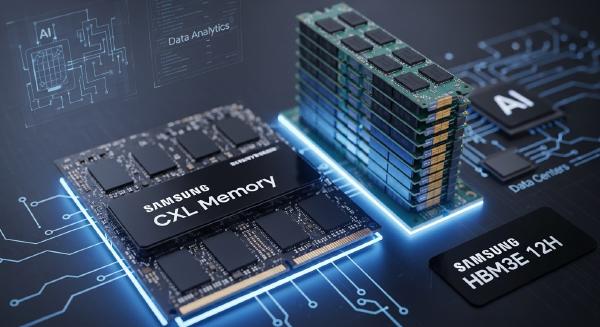
To address this, the industry is adopting Compute Express Link (CXL)—a high-speed interconnect that enables flexible and scalable memory architectures. One of the most promising innovations is using NAND flash over CXL to extend system memory at a much lower cost than DRAM.
⚡ What Is CXL (Compute Express Link)? #
CXL is an open-standard interconnect built on the PCIe physical layer, designed to enable high-speed communication between CPUs and memory or accelerators.
It allows multiple devices—such as CPUs, GPUs, and memory expanders—to share memory with low latency and high bandwidth.
Core CXL Protocols #
| Protocol | Function |
|---|---|
| CXL.io | Device discovery and configuration |
| CXL.cache | Enables device-side caching of host memory |
| CXL.mem | Allows CPU to access external memory via load/store |
The CXL.mem protocol is the key enabler for memory expansion using non-traditional memory technologies.
🧱 Breaking the DRAM–Flash Barrier #
Traditionally, there has been a fundamental divide between DRAM and NAND Flash.
Key Differences #
| Attribute | DRAM | NAND Flash |
|---|---|---|
| Access Type | Byte-addressable | Block-addressable |
| Speed | Very fast | Slower |
| Cost | High | Low |
| Density | Lower | Higher |
This gap is often referred to as the “semantic wall.”
How CXL Changes the Game #

With CXL.mem, NAND flash can be exposed to the CPU as memory-like resources, enabling:
- Direct load/store access
- Memory pool expansion
- Reduced reliance on expensive DRAM
This effectively transforms NAND from pure storage into a tiered memory solution.
🔮 NAND Over CXL: Use Cases and Technologies #
Different NAND technologies serve different roles when connected via CXL.

BiCS FLASH (3D NAND for Capacity) #
BiCS FLASH is designed for high-density memory expansion.
Key Characteristics #
- Massive storage capacity
- Lower cost per GB
- Suitable for bulk data access
Use Cases #
- AI training datasets
- Data lakes
- High-capacity memory pools
XL-FLASH (Low-Latency SCM) #
XL-FLASH is a type of Storage Class Memory (SCM) optimized for performance.
Key Characteristics #
- Lower latency than traditional NAND
- Higher random read/write performance
- Bridges gap between DRAM and NAND
Use Cases #

- AI inference workloads
- Real-time analytics
- Latency-sensitive applications
🚀 Benefits of CXL-Based NAND Memory #
CXL-enabled NAND introduces a new tier in the memory hierarchy.
Key Advantages #
-
Cost Efficiency
- Significantly lower cost per GB vs DRAM
-
Scalability
- Memory expansion beyond DIMM slot limitations
-
Power Efficiency
- Lower idle power compared to DRAM
-
Flexibility
- Dynamic memory pooling across devices
📊 DRAM vs CXL NAND Comparison #
| Feature | DRAM | CXL NAND |
|---|---|---|
| Latency | Ultra-low | Moderate |
| Cost per GB | High | Low |
| Capacity Scaling | Limited | Highly scalable |
| Power Consumption | Higher | Lower (idle) |
| Use Case | Primary memory | Extended memory tier |
🏗️ Impact on Data Center Architecture #
CXL-based memory expansion is reshaping modern infrastructure:
- Enables disaggregated memory architectures
- Supports memory pooling across servers
- Reduces dependency on expensive DRAM scaling
- Improves resource utilization in AI/HPC clusters
This is especially critical for workloads requiring massive datasets and parallel processing.
🔮 Future Outlook #
CXL-enabled NAND is expected to play a major role in next-generation systems:
-
AI/ML acceleration
- Larger memory pools for model training
-
High-Performance Computing (HPC)
- Efficient data access at scale
-
Tiered memory architectures
- DRAM + SCM + NAND hierarchy
-
Composable infrastructure
- Dynamic allocation of memory resources
✅ Conclusion #
CXL is fundamentally transforming how memory is designed and deployed in modern systems.
By enabling NAND flash to function as memory, it provides:
- Scalable capacity beyond DRAM limits
- Lower cost and power consumption
- Flexible architectures for AI and HPC workloads
As data demands continue to grow, CXL-based NAND solutions will become a cornerstone of next-generation data centers, bridging the gap between storage and memory.