Space Computing Power Explained: Architecture, Benefits, Challenges, and Future
Artificial intelligence is driving an unprecedented demand for computing power. As terrestrial data centers continue to expand, they face mounting challenges related to energy consumption, cooling, land availability, and infrastructure costs. These constraints have prompted researchers and aerospace companies to explore an entirely new frontier for large-scale computing: space.
Known as space computing or in-orbit computing, this emerging paradigm moves high-performance computing infrastructure beyond Earth’s surface and into orbit, where satellites equipped with advanced processors can execute AI workloads, process massive datasets, and collaborate as distributed computing clusters.
Although space-based computing has existed in primitive forms since the earliest satellites, recent advances in reusable launch vehicles, AI accelerators, and satellite networking have transformed it into one of the most ambitious directions for future computing infrastructure.
🚀 What Is Space Computing? #
Space computing refers to deploying computing hardware—including CPUs, GPUs, AI accelerators, storage systems, and networking equipment—directly aboard satellites operating in space.
Instead of transmitting every piece of collected data back to Earth for processing, satellites perform computation where the data is generated.
Modern space computing primarily targets Low Earth Orbit (LEO) constellations, where hundreds, thousands, or even millions of interconnected satellites can function as a distributed computing platform.
A simplified architecture looks like this:
Space Computing Network

   [ LEO Satellite ] ←→ Laser Links ←→ [ LEO Satellite ]
          │                                  │
     AI Processing                     AI Processing
          │                                  │
          └──────── Space Computing Network ────────┘
                          │
                 Ground Data Centers
          (Training, Storage, Cloud Services)
Unlike conventional servers installed inside terrestrial data centers, space computing systems must be specifically engineered to survive:
- Cosmic radiation
- High vacuum
- Extreme temperature fluctuations
- Strict power limitations
- Launch vibration and mechanical stress
- Tight mass and volume constraints
Every component—from processors to memory, networking hardware, and thermal systems—must be redesigned for reliable long-term operation in orbit.
🌍 From Space Exploration to AI Infrastructure #
Computing in space is not a new concept.
Early spacecraft already relied on onboard computers for navigation and mission control.
Historical milestones include:
- Sputnik 1, carrying simple electronic control systems.
- The Apollo Guidance Computer, which guided lunar missions using only 64 KB of memory.
- Decades of increasingly capable onboard processing for scientific satellites and planetary probes.
What has changed is the scale.
Today, the objective is no longer simply controlling spacecraft. The goal is to build large-scale distributed AI infrastructure operating entirely in orbit.
Growing interest has been fueled by companies pursuing reusable launch systems, satellite mega-constellations, and AI computing platforms.
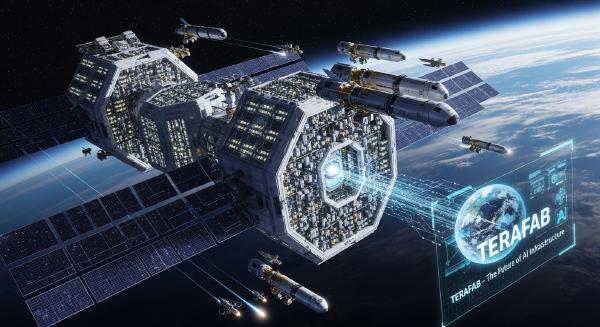
One notable example is SpaceX’s proposed Orbital Data Center System, which envisions deploying a massive constellation of computing satellites dedicated to AI workloads. Such initiatives have accelerated industry interest in space-based data centers as a potential extension of global AI infrastructure.
🛰 Primary Applications of Space Computing #
Space computing workloads generally fall into two major categories.
Aerospace Computing #
Traditional satellites collect enormous volumes of data through sensors, cameras, radar, and scientific instruments.
Historically, this followed a straightforward workflow:
Satellite Data Collection
        ↓
Data Transmission to Earth
        ↓
Ground-Based Processing
        ↓
Analysis and Decision Making
This model introduces several limitations:
- Limited communication bandwidth
- High transmission latency
- Large data transfer costs
- Delayed response times
Space computing enables a different approach.
Instead of sending raw data to Earth, satellites process information locally before transmitting only valuable results.
Satellite Data Collection
        ↓
Onboard AI Processing
        ↓
Filtering and Compression
        ↓
Actionable Results Sent to Earth
Benefits include:
- Faster decision making
- Reduced bandwidth usage
- Improved constellation coordination
- Real-time remote sensing
- Autonomous navigation
- Space debris avoidance
- Enhanced Earth observation
Ultimately, the industry is moving toward a Space-Earth Integrated Computing Network, where workloads are dynamically distributed across satellites, edge devices, and terrestrial cloud infrastructure.
Extending Ground Data Centers #
A second application involves treating orbital infrastructure as an extension of conventional cloud computing.
Instead of building increasingly larger facilities on Earth, AI workloads—particularly inference and selected training tasks—could be distributed across satellite clusters operating as space-based data centers.
These orbital systems would supplement terrestrial infrastructure while taking advantage of abundant solar energy and global connectivity.
☀️ Why Compute in Space? #
Several characteristics make space an attractive environment for future computing infrastructure.
Virtually Unlimited Solar Energy #
Outside Earth’s atmosphere, satellites receive uninterrupted solar radiation with far greater consistency than ground installations.
Large solar arrays in orbit can generate substantially more annual energy than equivalent systems located on Earth’s surface.
As AI data centers continue increasing electricity consumption, space-based power generation offers a potential path toward more sustainable computing.
Efficient Thermal Environment #
Although cooling in space presents unique engineering challenges, the surrounding vacuum eliminates atmospheric heating, dust, humidity, and environmental contamination.
Properly designed thermal radiation systems can dissipate heat without relying on water-intensive cooling infrastructure commonly used in terrestrial data centers.
Reduced Physical Infrastructure #
Traditional data centers require:
- Land acquisition
- Buildings
- Electrical infrastructure
- Cooling plants
- Extensive civil engineering
Orbital data centers eliminate many of these requirements, although they introduce new constraints involving launch logistics, orbital management, and spectrum allocation.
Global Coverage #
Satellites provide computing resources almost anywhere on Earth, including:
- Oceans
- Polar regions
- Deserts
- Remote forests
- Disaster zones
Low Earth Orbit also enables relatively low communication latency, making certain applications competitive with terrestrial cloud services.
Infrastructure Resilience #
Space-based computing can serve as an independent computing layer capable of maintaining critical services during natural disasters, infrastructure failures, or regional network disruptions.
This redundancy is particularly valuable for defense, emergency response, and critical infrastructure.
⚙️ Major Engineering Challenges #
Despite its promise, space computing faces formidable technical obstacles.
Power Generation and Energy Storage #
AI accelerators require enormous amounts of electricity.
Large orbital computing platforms must balance:
- Solar panel efficiency
- Battery capacity
- Satellite mass
- Deployment complexity
Because satellites regularly pass through Earth’s shadow, robust energy storage systems remain essential for uninterrupted operation.
Heat Dissipation #
Vacuum eliminates convective cooling.
Instead, heat must be removed through thermal radiation.
High-performance AI processors generate substantial thermal loads, requiring:
- Large radiator panels
- Liquid cooling systems
- Advanced thermal interfaces
- High-efficiency heat transfer materials
Managing heat remains one of the most significant engineering challenges for orbital AI infrastructure.
Radiation Hardening #
Space exposes electronics to intense radiation capable of causing:
- Single-event upsets (SEUs)
- Latch-up events (SELs)
- Memory corruption
- Permanent semiconductor damage
Mitigation techniques include:
- Radiation-hardened processors
- Error-correcting memory
- Hardware redundancy
- Triple Modular Redundancy (TMR)
- Protective shielding
These protections increase both complexity and manufacturing costs.
Maintenance and Service Life #
Unlike terrestrial servers, satellites cannot be easily repaired.
Hardware failures generally require replacement rather than maintenance.
This creates several challenges:
- Higher depreciation
- Shorter operational lifespan
- Fleet replenishment
- Orbital debris management
Reliability therefore becomes a primary design objective.
High-Speed Networking #
Distributed AI workloads require extremely fast communication between computing nodes.
Laser communication links provide significantly higher bandwidth than traditional radio-frequency systems while reducing spectrum congestion.
However, implementing optical networking requires:
- Precision pointing
- Stable tracking
- Atmospheric compensation for ground links
- Fault-tolerant routing
These remain active areas of research and development.
🤖 AI Is Driving the Next Generation of Space Infrastructure #
Artificial intelligence fundamentally changes the economics of space computing.
Modern AI workloads require enormous computing clusters connected by high-bandwidth interconnects.
As model sizes continue growing, expanding terrestrial infrastructure becomes increasingly constrained by:
- Power availability
- Cooling capacity
- Construction costs
- Grid limitations
Orbital computing offers an alternative approach where AI infrastructure scales beyond traditional geographic constraints.
Future space computing platforms may execute:
- Large language model inference
- Scientific simulations
- Earth observation analytics
- Climate modeling
- Autonomous satellite operations
- Distributed edge AI services
Rather than replacing terrestrial cloud infrastructure, orbital computing is expected to complement existing data centers by handling workloads that benefit from distributed processing, global coverage, or localized onboard computation.
🌐 Commercial Outlook #
Whether space computing becomes commercially viable depends on a combination of technological progress and economic feasibility.
Launch costs remain one of the most influential variables.
Continued advances in reusable launch systems are steadily reducing the cost of placing hardware into orbit, making large-scale orbital infrastructure increasingly practical.
At the same time, progress in semiconductor manufacturing, satellite production, optical networking, and AI accelerator efficiency is improving the long-term economics of space-based computing.
Nevertheless, several challenges remain before widespread commercial deployment becomes realistic:
- Capital-intensive infrastructure investments
- Satellite replacement cycles
- Radiation-resistant semiconductor manufacturing
- Large-scale orbital network management
- Regulatory approval for spectrum and orbital resources
- Long-term return on investment
The commercial success of space computing will ultimately depend on whether its operational advantages outweigh the costs of deployment and maintenance.
📈 Looking Ahead #
Space computing represents the convergence of aerospace engineering, distributed systems, artificial intelligence, and next-generation cloud infrastructure.
Although significant technical hurdles remain—including power management, thermal control, radiation protection, networking, and economic scalability—the pace of innovation across the aerospace and semiconductor industries continues to accelerate.
Rather than replacing traditional data centers, space computing is likely to become an additional layer of the global computing ecosystem, enabling new classes of AI applications that benefit from processing data closer to its source while extending computing capacity beyond the physical limits of Earth-based infrastructure.
As launch costs continue to decline and orbital technologies mature, space computing has the potential to become one of the defining infrastructure innovations of the AI era, reshaping how humanity builds, distributes, and scales computing power over the coming decades.