
AMD ROCm 7: A Serious Open-Source Challenge to NVIDIA CUDA
For more than a decade, NVIDIA CUDA has been the dominant software platform for GPU-accelerated AI and high-performance computing. Its combination of mature libraries, optimized compilers, development tools, and extensive framework support has created a powerful ecosystem advantage that extends well beyond GPU hardware.
AMD’s ROCm 7 represents one of the company’s most ambitious efforts to challenge that position. Early ROCm 7 components appeared publicly under the rocm-7.0.0 version tag, indicating that AMD’s next-generation software stack was approaching release.
Rather than positioning ROCm solely as a compatibility layer for existing CUDA workloads, AMD is targeting the complete AI software stack with higher inference throughput, improved training performance, broader framework support, tighter hardware integration, and stronger enterprise deployment capabilities.
🚀 ROCm 7 Performance and Architectural Improvements #
AMD previewed ROCm 7 at its Advancing AI event, highlighting substantial performance improvements over the previous generation and tighter integration with its latest Instinct accelerators.
Inference and Training Performance #
AMD claims that ROCm 7 can deliver up to 3.5× higher inference performance compared with ROCm 6 across supported workloads. The stack also introduces optimizations aimed at improving AI training efficiency and reducing performance gaps against established CUDA implementations.
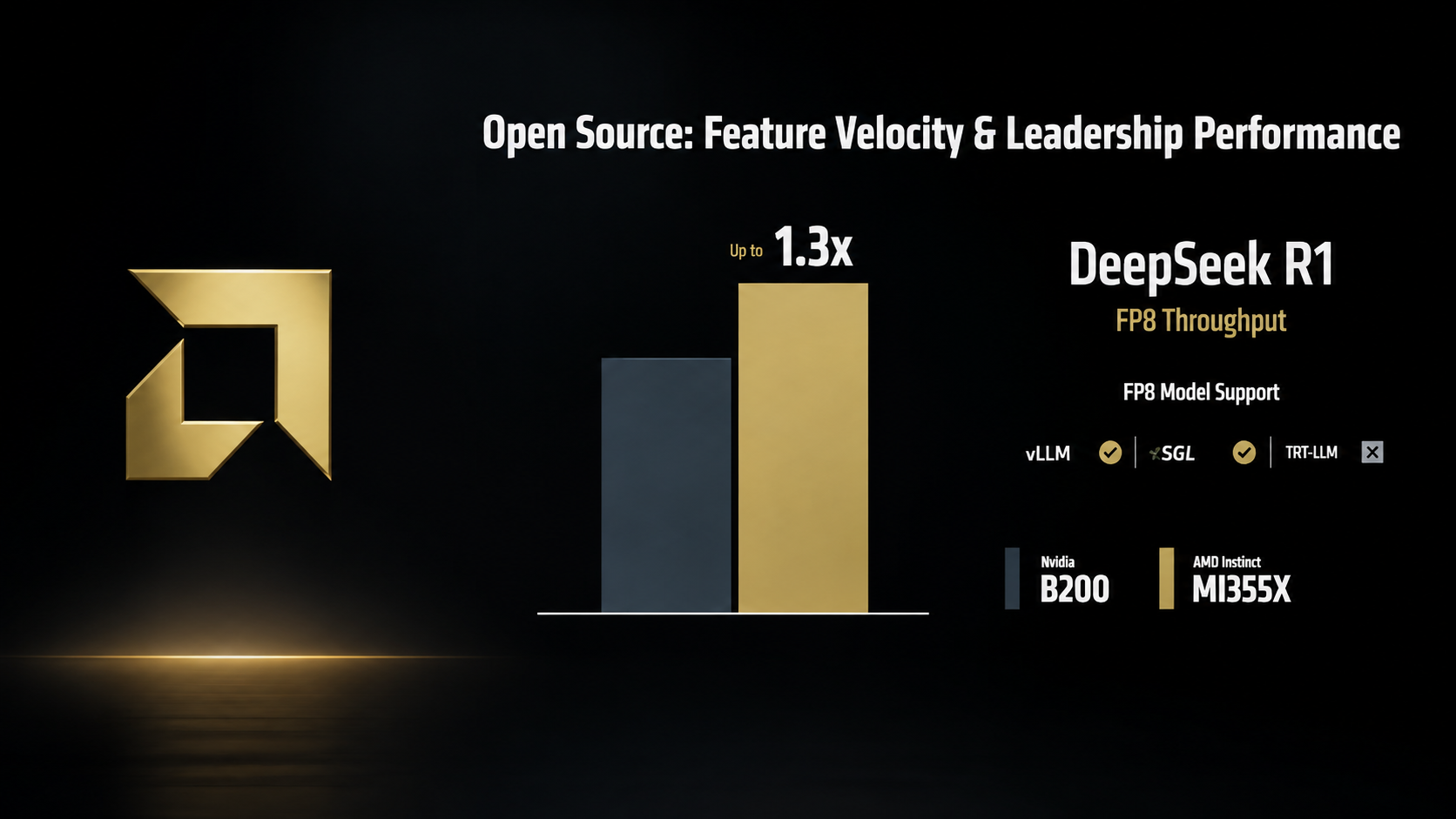
In AMD’s demonstrations, the Instinct MI355X reportedly outperformed NVIDIA’s Blackwell B200 by approximately 30% in FP8 throughput for the DeepSeek R1 workload. Such results are workload-dependent, but they illustrate AMD’s broader strategy: pair increasingly competitive accelerator hardware with software optimizations designed specifically around its architecture.
Broader Framework and Workload Support #
ROCm 7 expands the software stack across several layers of the AI development workflow:
- AI framework optimization: Improved support and performance across mainstream machine learning frameworks.
- Inference optimization: Greater emphasis on low-latency and high-throughput inference workloads.
- Training scalability: Support ranging from single-GPU development environments to large distributed clusters.
- Hardware integration: Native optimization for the AMD Instinct MI350 series and newer accelerator architectures.
- Enterprise deployment: Additional tooling for cluster management, deployment, and large-scale data center operations.
The objective is to make ROCm a complete production platform rather than simply an alternative GPU programming environment.
🔧 ROCm 7 vs. CUDA: Where the Competition Matters #
The central challenge for AMD is not simply matching NVIDIA GPU performance. CUDA’s competitive advantage comes from decades of ecosystem development.
CUDA provides developers with a mature programming model, optimized mathematical libraries, extensive documentation, profiling tools, third-party integrations, and broad adoption across cloud providers and AI research organizations. This ecosystem creates significant switching costs even when competing hardware offers attractive performance-per-dollar metrics.
ROCm 7 therefore needs to compete across multiple dimensions simultaneously:
- Software-hardware integration: Optimizing the complete stack around AMD Instinct accelerators.
- Developer accessibility: Maintaining an open-source approach that lowers barriers for developers and organizations evaluating alternative GPU platforms.
- Framework compatibility: Ensuring widely used AI frameworks and workloads perform efficiently without extensive application-level modification.
- Distributed computing: Scaling efficiently from workstation development to multi-node accelerator clusters.
- Enterprise readiness: Providing the operational and management tooling required for production AI infrastructure.
This makes ROCm 7 strategically important beyond any individual benchmark. AMD is attempting to reduce the software and ecosystem advantages that have historically reinforced NVIDIA’s hardware position.
🌐 Open-Source Strategy and Enterprise AI #
AMD’s open-source approach provides a fundamental distinction from NVIDIA’s proprietary CUDA ecosystem.
For developers and infrastructure operators, an increasingly capable ROCm stack introduces another option for deploying large-scale AI workloads. Organizations can evaluate AMD accelerators based on performance, cost, availability, power efficiency, and infrastructure requirements without treating CUDA compatibility as the only viable software path.
For hyperscalers and cloud providers, the implications are potentially larger. A stronger second GPU software ecosystem could provide greater negotiating leverage, reduce dependence on a single accelerator vendor, and create additional flexibility when designing AI clusters.
ROCm 7’s enterprise-oriented features are therefore just as important as its raw benchmark results. Successful adoption depends on whether organizations can deploy, monitor, scale, and maintain AMD GPU infrastructure with comparable operational efficiency.
📦 ROCm 7 and AMD Instinct Hardware #
ROCm’s effectiveness is closely tied to AMD’s Instinct accelerator roadmap.
The software stack is designed to expose and optimize capabilities in AMD’s latest data center GPUs, allowing the hardware and software layers to evolve together. This approach is particularly important for workloads involving low-precision inference, large language models, distributed training, and high-bandwidth accelerator memory.
The Instinct MI355X serves as an important example of this strategy. Rather than competing exclusively through raw silicon specifications, AMD can use ROCm-level optimizations to extract additional performance from its accelerator architecture and provide developers with a more integrated platform.
This hardware-software co-design is essential if AMD wants to convert accelerator performance advantages in individual workloads into sustained production adoption.
🔬 Public Development Signals and Release Status #
The appearance of ROCm 7 components on GitHub, including projects such as HIP and AOMP, provided an early indication that AMD’s next-generation software stack was progressing toward a broader release.
HIP remains particularly important because it provides AMD’s programming interface for porting and developing GPU applications, while AOMP supports AMD’s compiler ecosystem. Continued development across these components indicates that ROCm 7 is being developed as a broad software platform rather than as an isolated runtime update.
However, the presence of development components alone does not guarantee that every planned capability will reach production with identical performance or compatibility. Real-world adoption will ultimately depend on release stability, framework support, documentation, tooling, and application-level optimization.
⚔️ Can ROCm 7 Challenge CUDA’s Dominance? #
ROCm 7 does not need to completely displace CUDA to materially change the AI computing market.
Even incremental improvements in AMD’s software ecosystem could make Instinct accelerators more attractive to cloud providers, enterprises, and AI developers. As AMD improves compatibility and performance, the cost of moving workloads away from CUDA can decline.
The competitive equation can therefore be summarized across three layers:
- Hardware: AMD continues improving Instinct accelerator performance and memory capabilities.
- Software: ROCm 7 reduces the ecosystem and optimization gap with CUDA.
- Infrastructure: Enterprise deployment and cloud integration make AMD accelerators easier to operate at scale.
If AMD can maintain progress across all three layers, ROCm can evolve from a secondary GPU software stack into a credible alternative for production AI infrastructure.
🧠 What ROCm 7 Means for AI Developers and Enterprises #
For developers, a stronger ROCm ecosystem means greater freedom in choosing accelerator hardware and potentially less dependence on a single proprietary platform.
For enterprises, the benefits extend to infrastructure economics and vendor diversification. A capable alternative to CUDA can improve purchasing flexibility while encouraging competition around accelerator pricing, performance, availability, and software support.
The larger significance is that the AI hardware race is increasingly becoming a software ecosystem race. Accelerator silicon can deliver impressive theoretical performance, but production workloads depend on compilers, kernels, libraries, frameworks, orchestration, profiling, and distributed execution.
AMD’s ROCm 7 strategy recognizes this reality.
🎯 Final Thoughts #
ROCm 7 is more than a routine software revision for AMD. It represents a broader attempt to establish a competitive AI computing platform around Instinct accelerators and reduce the software advantage that has helped CUDA maintain its dominant position.
AMD still faces a substantial ecosystem gap. NVIDIA has years of developer adoption, optimized libraries, tooling, and production deployments behind CUDA. Closing that gap requires sustained investment rather than a single release.
Nevertheless, the combination of improved inference performance, stronger training support, deeper Instinct integration, enterprise capabilities, and an open-source development model gives ROCm 7 a significantly stronger competitive position.
If AMD can continue improving software compatibility and real-world workload performance, ROCm could become one of the most important alternatives to CUDA in the next phase of AI infrastructure development.