AMD Zen 6 Roadmap: Ultra-Low Power Cores, 2nm CPUs, and Memory-on-Package
AMD’s latest hardware disclosures reveal a significant evolution across its entire processor portfolio. Rather than simply increasing core counts or chasing higher clock speeds, the company is reshaping its CPU architecture to improve power efficiency, expand AI capabilities, and address specialized embedded markets with long product life cycles.
The roadmap spans three major initiatives:
- A brand-new Zen 6 Low Power (LP) core architecture designed to improve battery life on mobile platforms.
- Next-generation 2nm Zen 6 desktop and workstation processors featuring higher core density and integrated AI acceleration.
- The introduction of Versal Premium Gen 2 Memory-on-Package (MoP) adaptive SoCs for industrial, aerospace, and defense deployments.
Together, these developments illustrate AMD’s strategy of optimizing every computing segment—from ultraportable laptops to AI workstations and mission-critical embedded systems.
🔋 Zen 6 Introduces an Ultra-Low Power Core Tier #
One of the most notable architectural changes arrives with Zen 6 (“Morpheus”), where AMD expands beyond its familiar two-tier hybrid design.
From Two Core Types to Three #
Previous Zen generations paired standard Zen cores with dense Zen c variants.
Unlike Intel’s Performance (P) and Efficiency (E) cores, AMD’s compact cores maintained:
- The same ISA
- Identical instruction support
- Comparable IPC
- Smaller cache
- Reduced operating frequency
- Higher transistor density
With Zen 6, Linux kernel patches indicate support for a third x86 core category identified as EB2, internally described as a Low Power Core.
The architecture now consists of:
| Core Type | Purpose |
|---|---|
| Performance Core (EB0) | Heavy workloads and maximum performance |
| Efficiency Core (EB1) | Balanced throughput and power efficiency |
| Low Power Core (EB2) | Ultra-light background processing during idle operation |
This marks AMD’s first implementation of a dedicated ultra-low-power execution layer.
Designed for Background Workloads #
The Zen 6 LP core targets tasks that rarely require high-performance compute resources, including:
- Audio playback
- Notification handling
- Background synchronization
- System housekeeping
- Low-priority operating system services
Keeping these workloads isolated allows larger compute cores to remain in deep sleep states, significantly reducing idle and light-load power consumption.
This design closely resembles Intel’s Low Power Island strategy while addressing one of AMD’s longstanding weaknesses in battery efficiency compared with Apple Silicon and Intel mobile processors.
Medusa Mobile Platforms Lead the Transition #
The triple-hybrid architecture is expected to debut with AMD’s next-generation Medusa mobile APUs.
Two primary product families are expected:
Medusa Point #
Designed for mainstream notebooks, Medusa Point balances performance, graphics, and battery life for consumer laptops.
Medusa Halo #
The premium variant pushes integrated graphics substantially further, reportedly offering:
- Up to 48 RDNA 5 Compute Units
- Approximately 20 MB of L2 cache
- Next-generation Infinity Fabric improvements
- Enhanced low-load power optimization
These upgrades position Medusa Halo as AMD’s flagship mobile APU for high-performance laptops.
Desktop CPUs Remain Unchanged #
AMD has confirmed that the Low Power core architecture will remain exclusive to mobile processors.
Traditional desktop CPUs prioritize maximum performance over battery efficiency, making the additional LP layer unnecessary for mainstream desktop systems.
🖥️ Zen 6 Desktop and Workstation Platforms Emerge #
Early support added to AIDA64 Extreme Beta provides additional evidence for several upcoming Zen 6 processor families manufactured using TSMC’s advanced 2nm process.
Olympic Ridge: The Next Consumer Desktop Platform #
Olympic Ridge succeeds the Ryzen 9000 series and introduces substantial architectural changes.
Higher Core Density #
The new Powderhorn CCD reportedly increases chiplet density from:
- 8 cores per CCD
- to 12 cores per CCD
As a result, mainstream desktop processors could scale up to:
- 24 CPU cores
- 48 threads
without requiring additional chiplets.
AI Takes Priority Over Integrated Graphics #
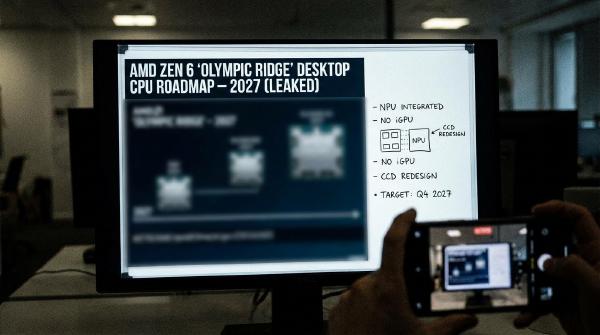
One of the more surprising rumors suggests AMD may eliminate the integrated graphics engine previously introduced on AM5 desktop processors.
Instead, the reclaimed die space would accommodate a dedicated Neural Processing Unit (NPU) within the I/O die.
Potential benefits include:
- Local AI inference acceleration
- Windows AI workloads
- AI-assisted productivity software
- Reduced CPU utilization during machine learning tasks
If accurate, this would represent AMD’s first desktop platform with native hardware AI acceleration built directly into mainstream processors.
Long-Term AM5 Support #
AMD also reaffirmed that Socket AM5 remains supported through at least 2029, allowing existing motherboard owners to upgrade to Zen 6 without changing platforms.
Mustang Peak Expands Threadripper Performance #
AMD’s next-generation workstation platform, internally known as Mustang Peak, targets professional creators, scientific computing, engineering, and enterprise workloads.
Massive Core Count Increase #
By leveraging the new 12-core CCD design, Threadripper Pro could scale to:
- 144 CPU cores
- 288 processing threads
This represents approximately a 50% increase over today’s 96-core flagship models.
PCIe 6.0 Arrives #
Supporting such dense parallel computing requires significantly more I/O bandwidth.
Mustang Peak is expected to introduce:
- Native PCIe 6.0
- Up to 256 GB/s bidirectional bandwidth
- Expanded DDR5 memory support
- Higher aggregate memory throughput
These improvements target AI development, simulation, rendering, virtualization, and scientific workloads where both compute density and bandwidth are critical.
🧠 Versal Premium Gen 2 Brings Memory-on-Package to Embedded Systems #
Beyond consumer processors, AMD has officially unveiled the Versal Premium Gen 2 Memory-on-Package (MoP) adaptive SoC family.
Unlike Ryzen or EPYC, these processors focus on industries where reliability and long-term deployment matter more than peak benchmark performance.
Key Specifications #
| Feature | Specification | Practical Benefit |
|---|---|---|
| Memory Integration | Up to 32 GB LPDDR5X (9000 Mb/s) | Saves up to 60% of PCB space |
| Memory Bandwidth | 288 GB/s | Accelerates AI inference, radar, and signal processing |
| High-Speed Interfaces | PCIe 6.0 and CXL 3.1 | Enables high-speed connectivity and memory expansion |
| Operating Temperature | -40°C to 110°C | Suitable for harsh industrial environments |
| Product Longevity | 15+ years | Reduces redesign costs for long-life deployments |
These systems target applications such as:
- Aerospace
- Defense
- Industrial automation
- Telecommunications
- Edge AI
- Medical equipment
- Transportation infrastructure
⚙️ Why AMD Chose LPDDR5X Instead of HBM #
Although High Bandwidth Memory dominates AI accelerators and modern data centers, it presents several challenges for industrial systems.
Limitations of HBM #
HBM offers exceptional bandwidth but comes with notable trade-offs:
- Short product life cycles
- Frequent generation transitions
- High manufacturing costs
- Complex packaging requirements
- Limited suitability for extreme environmental conditions
For embedded deployments expected to remain operational for well over a decade, these drawbacks become significant.
Memory-on-Package Offers a Different Balance #
AMD instead integrates JEDEC-standard LPDDR5X directly beside the compute die using a compact 0.4 mm interconnect pitch.
This design delivers several engineering advantages:
- Simplified PCB routing
- Reduced signal integrity challenges
- Faster hardware development
- Lower manufacturing complexity
- Improved long-term component availability
Rather than maximizing absolute bandwidth, the architecture prioritizes deployment reliability, maintainability, and lifecycle stability.
Engineering samples are expected later this year, with volume production anticipated in late 2027.
📊 Strategic Implications #
Taken together, these announcements reveal a broader strategic transformation for AMD.
The company is simultaneously pursuing multiple objectives:
- Closing the mobile power-efficiency gap through dedicated Low Power cores.
- Increasing desktop compute density while preparing consumer platforms for AI-native software.
- Expanding Threadripper into even higher-performance workstation territory.
- Strengthening its position in industrial and defense markets with long-lifecycle adaptive SoCs.
Rather than relying on a single architectural breakthrough, AMD is tailoring its processor designs to the unique requirements of each market segment. Mobile devices prioritize battery life, desktops gain AI acceleration, workstations scale compute density, and embedded platforms focus on reliability and longevity.
If these roadmaps materialize as expected, Zen 6 will represent one of AMD’s most comprehensive architectural transitions since the original Zen launch, extending beyond raw CPU performance to encompass efficiency, AI integration, and specialized computing infrastructure.