Intel Panther Lake Takes the IPC Crown from AMD Zen 5
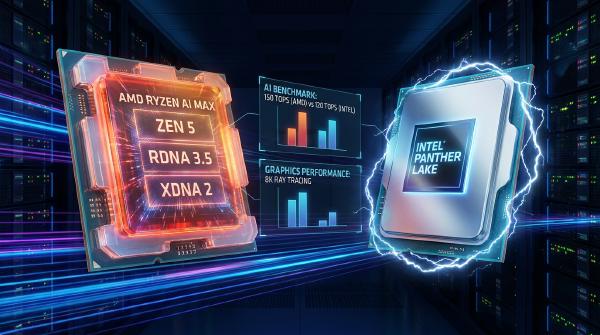
In early 2026, new data from independent hardware reviewers—including controlled runs under WSL 2 using the SPEC CPU 2017 benchmark suite—revealed a clear architectural shift. Intel’s Panther Lake has taken a measurable lead in IPC (Instructions Per Cycle) over AMD’s flagship Strix Halo based on Zen 5.
While AMD continues to dominate in raw multi-core throughput, Panther Lake’s results confirm that Intel is winning the performance-per-hertz battle this generation.
🚀 Cougar Cove vs. Zen 5: IPC Leadership #
At the core of Panther Lake is Intel’s new Cougar Cove P-core, designed around microarchitectural efficiency rather than frequency scaling.
Key observations from SPEC CPU 2017 integer workloads include:
-
~10% IPC Advantage
When normalized for clock speed, Cougar Cove delivers roughly 10% higher IPC than Zen 5. -
Frontend-Centric Gains
The improvement comes primarily from:- Wider frontend queues
- Improved branch prediction
- Reduced pipeline bubbles
Instead of chasing GHz, Intel focused on extracting more work from each cycle—a classic high-IPC strategy.
🔋 Darkmont vs. Zen 5c: Efficiency Core Showdown #
Intel’s efficiency core evolution, Darkmont, also shows meaningful gains over AMD’s dense-core design, Zen 5c.
-
~6% IPC Lead
Darkmont cores are approximately 6% faster clock-for-clock than Zen 5c. -
Practical Impact
Darkmont can now handle background tasks and parallel workloads at performance levels that rival older-generation “big” cores. This allows Panther Lake to sustain responsiveness even at lower power envelopes.
This significantly narrows the historical gap between efficiency cores and performance cores.
📊 SPEC CPU 2017: Normalized IPC Efficiency #
Based on reviewer deep dives and SPECint_rate-per-GHz normalization, the following efficiency picture emerges:
| Core Architecture | Platform | IPC Efficiency Index | Relative Position |
|---|---|---|---|
| Cougar Cove (P) | Intel Panther Lake | 1.10 | +10% vs Zen 5 |
| Zen 5 (P) | AMD Strix Halo | 1.00 | Baseline |
| Darkmont (E) | Intel Panther Lake | 0.78 | +6% vs Zen 5c |
| Zen 5c (c) | AMD Strix Halo | 0.73 | Baseline (E-core class) |
These figures reflect efficiency per cycle, not total throughput.
🛠️ Why This Matters at the System Level #
Although Strix Halo can still dominate heavily threaded workloads thanks to its 16C / 32T Zen 5 configuration and large caches, Panther Lake is optimized for how systems feel in daily use.
-
Lower Per-Task Latency
Higher IPC improves responsiveness in single-threaded workloads, gaming, and UI-driven tasks. -
Smarter Scheduling
With strong IPC across P, E, and LP-E cores, Intel’s Thread Director can migrate workloads more freely without noticeable performance drops. -
18A Process Advantage
Built on Intel 18A, Panther Lake sustains competitive performance while consuming up to 40% less power in single-threaded scenarios compared to Arrow Lake.
🧠 Summary #
The SPEC CPU 2017 data confirms that Panther Lake is not a minor refresh. It represents a deliberate architectural shift toward execution efficiency per cycle, signaling Intel’s move away from the core-count arms race.
For 2026 laptops, handhelds, and power-sensitive platforms, Panther Lake’s high-IPC design positions Intel strongly in the responsiveness and efficiency segment—where real-world user experience is often decided.