Nvidia RTX Spark AI PC Pricing Revealed: Up to $2,899 at Launch
Nvidia’s long-awaited RTX Spark AI PC platform has officially entered the spotlight, but its pricing may prove just as noteworthy as its hardware capabilities. According to industry survey data presented during Computex 2026, RTX Spark systems will launch firmly in the premium segment, with flagship configurations approaching workstation-class pricing.
The reported pricing positions Nvidia’s first-generation AI PCs well above mainstream consumer laptops, highlighting both the technological ambition and current cost realities of running advanced AI workloads locally.
💰 Premium Pricing Sets a High Entry Barrier #
Nvidia has repeatedly emphasized its vision of bringing local AI acceleration to personal computing, positioning RTX Spark as a platform capable of making AI workloads as commonplace as traditional desktop applications.
However, newly disclosed pricing suggests widespread adoption may take longer than anticipated.
According to a Morgan Stanley survey of PC manufacturers:
| Model | Starting Price (USD) | Approximate Price (RMB) |
|---|---|---|
| RTX Spark N1 | $1,799 | 12,000+ RMB |
| RTX Spark N1x | $2,899 | Nearly 20,000 RMB |
These figures place RTX Spark systems significantly above the price range of conventional consumer laptops and desktops.
For comparison, many mainstream productivity laptops and gaming PCs currently sell for less than half the cost of the flagship N1x configuration.
As a result, Nvidia’s initial AI PC rollout appears targeted primarily at professionals, developers, and power users rather than mass-market consumers.
⚙️ Hardware Specifications Push Into Workstation Territory #
The premium pricing becomes easier to understand when examining the underlying hardware.
Unlike traditional laptops that combine off-the-shelf CPUs and GPUs, RTX Spark systems are designed around Nvidia’s tightly integrated AI-focused architecture.
Flagship N1x Configuration #
The top-tier N1x model reportedly includes:
- TSMC 3nm manufacturing process
- 20-core Grace CPU
- 10 ARM Cortex-X925 performance cores
- 10 ARM Cortex-A725 efficiency cores
- Blackwell-based RTX 5070 GPU
- 6,144 CUDA cores
- Up to 1 PFLOPS of FP4 AI performance
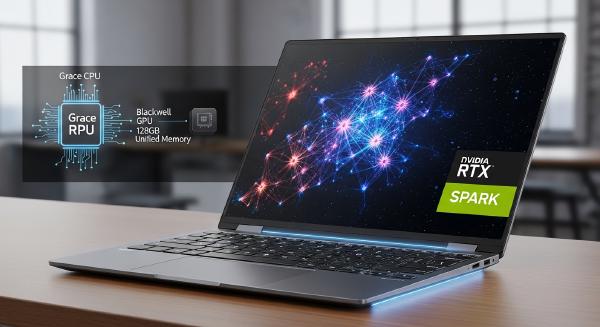
- Up to 128GB LPDDR5X unified memory
- NVLink-C2C interconnect with 600 GB/s bandwidth
The unified memory architecture allows both CPU and GPU to access the same memory pool, reducing bottlenecks commonly found in discrete GPU systems and improving efficiency for large AI workloads.
Entry-Level N1 Configuration #
Even the lower-end N1 model offers specifications beyond typical consumer hardware:
- 12-core Grace CPU
- 8 Cortex-X925 cores
- 4 Cortex-A725 cores
- GeForce RTX 5050 graphics
- Up to 64GB unified memory
- Dedicated AI acceleration capabilities
While positioned as the entry-level option, the N1 still exceeds the memory capacity and AI performance offered by most mainstream laptops currently available.
🔮 Built for Local AI Workloads #
The defining characteristic of RTX Spark is its focus on running AI applications locally rather than relying on cloud infrastructure.
Nvidia’s platform includes support for its complete AI software ecosystem, including:
- CUDA
- TensorRT
- DLSS 4.5
- RTX ray tracing technologies
- AI inference acceleration frameworks
This combination enables workloads that traditionally required remote servers or specialized workstations.
Large Language Models #
With up to 128GB of unified memory available, RTX Spark systems are expected to support:
- Local inference for large language models
- Fine-tuning smaller AI models
- Agent-based AI workflows
- Private AI deployments without cloud dependence
For developers and enterprise users concerned with privacy, latency, or recurring cloud costs, local execution can offer significant advantages.
AI Content Creation #
The platform is also designed for professional creative workloads, including:
- AI image generation
- AI-assisted video editing
- Generative media workflows
- Real-time content enhancement
These workloads benefit directly from the combination of Blackwell GPU acceleration and high-bandwidth shared memory.
Gaming and Real-Time Rendering #
Beyond AI applications, RTX Spark aims to deliver high-end gaming performance through:
- Full ray tracing support
- Advanced upscaling technologies
- Real-time 4K rendering
- High-frame-rate AAA gaming experiences
The platform effectively combines workstation-class AI capabilities with enthusiast-grade gaming performance.
📈 Why Nvidia Is Betting on Unified AI Computing #
RTX Spark reflects a broader industry trend toward integrating AI acceleration directly into personal computing devices.
Traditional PCs were designed around separate CPU and GPU resources optimized primarily for productivity and graphics workloads. AI applications introduce new requirements:
- Massive memory capacity
- High-bandwidth interconnects
- Specialized tensor processing
- Efficient model deployment
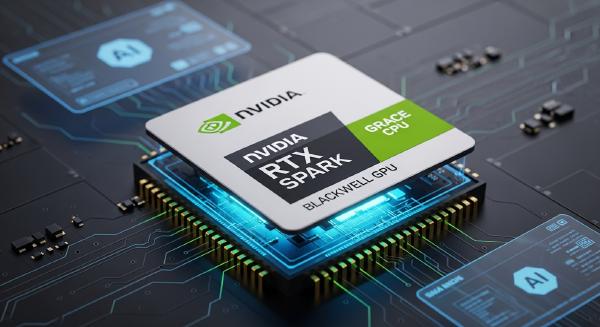
By combining Grace CPUs, Blackwell GPUs, and unified memory into a tightly integrated platform, Nvidia is attempting to create a PC architecture optimized specifically for the AI era.
This approach mirrors strategies increasingly seen across the industry, including Apple’s unified memory architecture and emerging Arm-based AI computing platforms.
💡 Who Should Consider an RTX Spark AI PC? #
The reported pricing fundamentally changes the target audience for first-generation RTX Spark systems.
Users Who May Not Need One #
For most consumers, existing hardware remains more than sufficient for everyday computing tasks.
Typical workloads such as:
- Web browsing
- Office productivity
- Streaming media
- Casual content creation
- General-purpose AI assistants
can already be handled effectively by modern x86 and Arm-based laptops.
Users expecting an affordable AI PC in the 5,000–6,000 RMB range will likely find RTX Spark’s launch pricing difficult to justify.
Users Who Could Benefit #
RTX Spark becomes more compelling for professionals whose workflows directly depend on local compute performance.
Potential buyers include:
- AI developers
- Machine learning engineers
- Professional content creators
- Video production specialists
- Technical researchers
- High-end gaming enthusiasts
For these users, the productivity gains from local AI execution, large memory capacity, and workstation-grade hardware may offset the higher upfront investment.
🔮 The Bigger Picture for AI PCs #
The launch pricing of RTX Spark highlights a broader reality about the current state of edge AI computing.
While AI PCs have become one of the industry’s most heavily promoted categories, the hardware required to run advanced AI models locally remains expensive. Memory capacity, interconnect bandwidth, and AI-optimized silicon continue to command a significant premium.
As a result, first-generation AI PCs are entering the market as premium productivity machines rather than mass-market consumer devices.
Over time, increased competition from Arm vendors, x86 manufacturers, and future Nvidia iterations will likely drive prices downward. For now, however, RTX Spark represents the cutting edge of local AI computing—and cutting-edge hardware rarely comes cheap.
For professionals seeking workstation-class AI performance in a desktop or laptop form factor, RTX Spark may be one of the most capable platforms available. For everyone else, waiting for second-generation products and independent real-world reviews may be the more practical approach.