Valve Steam Machine: AMD Zen 4 and RDNA 3 Explained
Valve has unveiled its next-generation Steam Machine, bringing the company’s SteamOS ecosystem back to the living room with substantially more performance than the Steam Deck.
The new system combines a semi-custom AMD Zen 4 CPU and RDNA 3 GPU in a compact desktop-style enclosure. Rather than behaving like a conventional closed console, the Steam Machine retains the flexibility of a PC while adopting a console-oriented interface, fast sleep and wake behavior, and tight integration with Steam.
The result is a system positioned between traditional game consoles and compact gaming PCs, with hardware designed specifically for the Steam ecosystem.
⚙️ AMD Zen 4 + RDNA 3 Performance #
At the center of the Steam Machine is a semi-custom AMD APU combining a Zen 4 CPU with an RDNA 3 graphics architecture.
The reported configuration includes:
- 6-core AMD Zen 4 CPU
- Up to 4.8 GHz CPU clock
- RDNA 3 GPU
- 28 Compute Units
- 8 GB GDDR6 graphics memory
- 16 GB DDR5 SO-DIMM system memory
- 512 GB or 2 TB SSD storage options
- microSD expansion
Valve is targeting high-resolution living-room gaming, including 4K output at up to 60 FPS with the assistance of AMD’s FidelityFX Super Resolution (FSR) upscaling technology.
Raw GPU throughput is only part of the equation. Resolution scaling, game engine optimization, memory bandwidth, shader workload, and frame-generation or reconstruction techniques all affect actual game performance.
Valve has also positioned the system as a major performance increase over the original Steam Deck. From an FP32 floating-point perspective, Valve states that the PS5 is roughly five times more powerful than the original Steam Deck.
The Steam Machine is therefore best understood as a substantially higher-performance SteamOS system rather than simply a larger Steam Deck.
CPU and GPU architecture #
The combination of Zen 4 and RDNA 3 gives Valve a modern AMD heterogeneous compute platform.
The Zen 4 CPU provides considerably more CPU resources than the Steam Deck’s Zen 2-based processor, while the RDNA 3 GPU provides a significantly larger graphics subsystem.
This additional headroom is particularly relevant for:
- Higher-resolution rendering.
- More demanding game engines.
- Higher frame-rate targets.
- CPU-heavy simulation and game logic.
- Larger open-world environments.
- More aggressive texture and asset streaming.
The system’s actual gaming performance will still vary significantly by title and rendering configuration.
🧊 Compact Industrial Design #
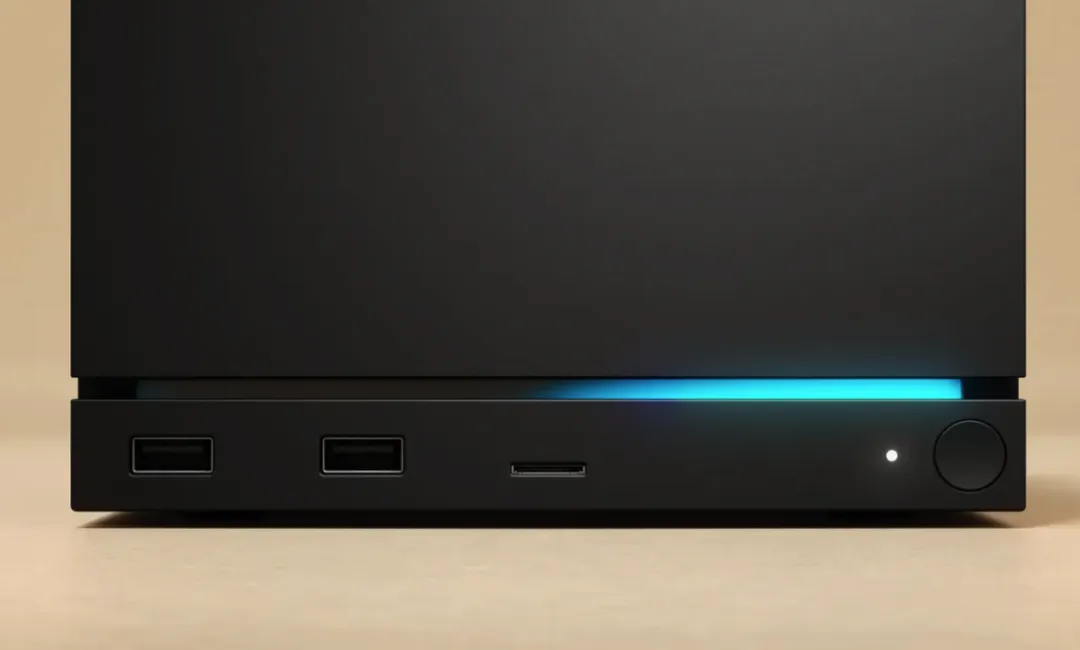
The Steam Machine uses a minimalist 16 cm cube-like enclosure designed to fit naturally into a living-room environment.
The internal layout separates the primary compute hardware from the cooling system, with the main components positioned toward the lower portion of the enclosure and cooling hardware occupying the upper section.
A front light strip provides visual feedback for system states such as startup, updates, and downloads.
The front panel is magnetically attached and designed to be replaceable. Valve also plans to provide 3D-printing files, allowing users to create custom front covers.
This is an interesting departure from traditional console hardware, where external customization is usually limited to officially manufactured accessories.
Connectivity #
The rear I/O includes:
- DisplayPort 1.4
- HDMI 2.0
- 1 GbE Ethernet
- USB-C 3.2 Gen 2
- Four USB-A ports
Wireless connectivity includes Wi-Fi 6E and Bluetooth 5.3.
The system also integrates a Steam Controller receiver, removing the need for a separate external receiver for supported Valve controllers.
Power is supplied by an internal 300 W PSU, keeping the external setup relatively clean.
🖥️ SteamOS as the Console Layer #
The Steam Machine runs SteamOS, using the same general interface philosophy established by the Steam Deck.
The important distinction is that SteamOS does not turn the hardware into a conventional locked-down console. The underlying system remains a PC, giving users considerably more flexibility over applications and operating-system configuration.
Users can install applications and, where supported, replace SteamOS with another operating system.
Valve’s Steam Verified compatibility system provides a standardized way to communicate whether games are expected to work correctly on the platform.
This approach addresses one of the major challenges of PC gaming in the living room: maintaining PC flexibility without requiring users to interact with a traditional desktop interface every time they launch a game.
🎮 Seamless Steam Ecosystem Integration #
The Steam Machine is designed to operate as another endpoint within Valve’s broader hardware ecosystem.
It supports multiple game controllers, including up to four Steam Deck-compatible controllers, as well as other Bluetooth gamepads.
Valve’s own controllers receive additional system-level integration, including the ability to wake the Steam Machine.
Steam Link and cross-device streaming #
Integration with Steam Link allows games to be streamed between compatible devices.
This creates a broader ecosystem connecting systems such as:
- Steam Machine
- Steam Deck
- Steam Frame
- Other Steam Link-compatible devices
The architecture effectively separates the location where a game is executed from the location where it is displayed.
A demanding title can therefore run on the more powerful living-room hardware while another Steam device acts as the client.
🎛️ New Steam Controller with TMR Joysticks #
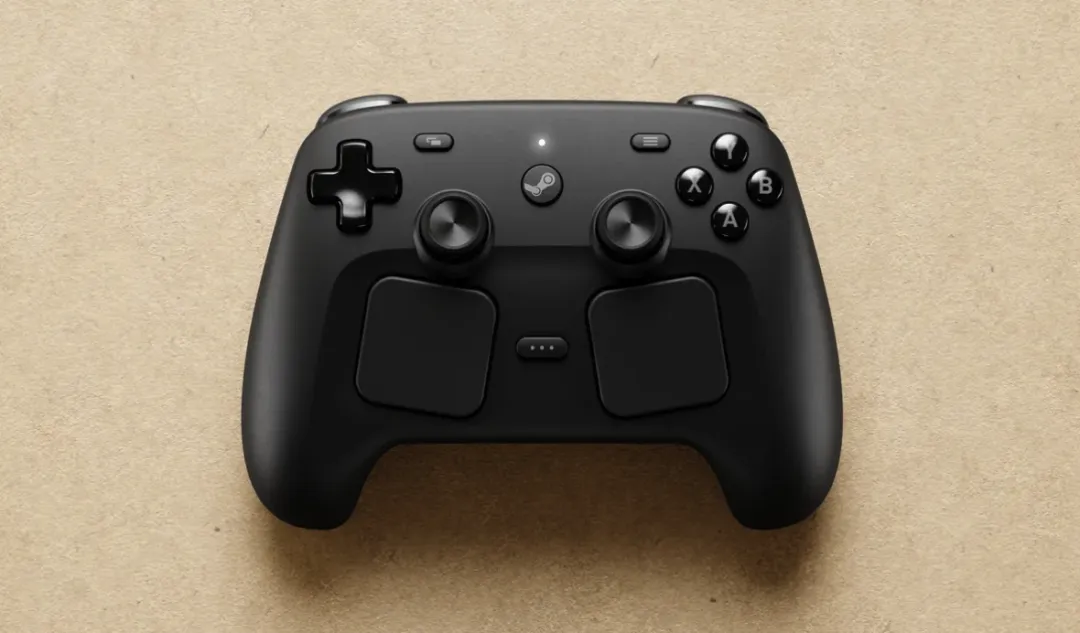
Valve has also introduced a new Steam Controller alongside the Steam Machine.
One of its most notable hardware changes is the adoption of TMR (Tunnel Magnetoresistance) joystick sensors.
TMR sensing can provide high-resolution position detection while avoiding the mechanical contact used by traditional potentiometer-based joysticks. Compared with conventional Hall-effect implementations, TMR technology can also offer different trade-offs in sensitivity, power consumption, and sensing resolution depending on the implementation.
The controller combines the new joysticks with capacitive sensing, motion control, and an enhanced haptic feedback system.
Its control layout includes:
- 4 face buttons
- 4 shoulder buttons
- 4 rear paddles
- 2 joysticks
- 2 trackpads
Grip Sense and motion input #
Valve’s new Grip Sense system combines capacitive grip detection with gyroscope-based aiming.
This allows the controller to detect how the user is holding it and combine that information with motion input. The approach is particularly relevant to first-person shooters, where fine-grained gyro aiming can complement conventional analog-stick control.
The controller also supports automatic loading of community-created control mappings when pairing with supported games, while retaining full customization for users who prefer to configure controls manually.
🏠 A Bridge Between PC and Console Gaming #
The Steam Machine’s most important characteristic is arguably not its raw hardware specifications but its operating model.
It is a fully functional PC presented through a console-oriented interface.
That distinction gives the system access to the Steam ecosystem while retaining capabilities normally associated with desktop PCs.
The living-room experience is built around several layers:
- SteamOS provides the console-style interface.
- Steam provides the software and game distribution ecosystem.
- AMD hardware provides the CPU and GPU compute platform.
- Steam Input provides extensive controller customization.
- Steam Link connects the system to other devices.
- PC openness allows users to install additional software or replace the operating system.
This makes the Steam Machine fundamentally different from a traditional closed console architecture.
Where the Steam Machine fits #
Rather than requiring users to choose between a conventional console and a desktop gaming PC, Valve is extending the Steam ecosystem into another hardware form factor.
The combination of SteamOS, AMD Zen 4, RDNA 3 graphics, fast sleep/wake behavior, extensive controller support, and access to the broader Steam library is designed to make PC gaming behave more like a dedicated living-room console.
Its success will ultimately depend on factors beyond the hardware specification, including pricing, game compatibility, software support, and real-world performance across different workloads.
Expected release: Early 2026.