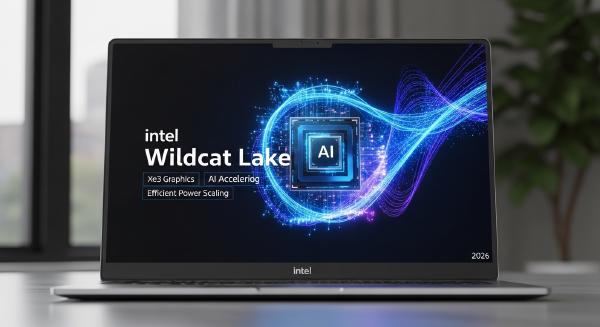
Intel Wildcat Lake Targets Budget AI Laptops With 18A
Intel has officially launched its 3rd-generation Core mobile processors, codenamed Wildcat Lake, alongside a broader manufacturing initiative called Project Firefly. Together, the two announcements represent Intel’s most aggressive attempt yet to redefine the affordable Windows laptop market in response to Apple’s disruptive low-cost ultraportable strategy.
Rather than chasing Apple through brute-force silicon scaling alone, Intel is restructuring the economics of mainstream laptop design itself.
The combination of advanced Intel 18A compute silicon, disaggregated packaging, simplified motherboard layouts, and smartphone-inspired manufacturing techniques is designed to deliver thinner, quieter, AI-capable Windows laptops at significantly lower production costs.
The result is a platform aimed directly at the sub-$600 notebook category without abandoning modern AI acceleration capabilities.
🧩 Wildcat Lake’s Disaggregated Architecture #
Wildcat Lake adopts a modular chiplet-style layout that separates high-performance compute logic from lower-cost platform functionality.
WILDCAT LAKE DISAGGREGATED DESIGN

┌──────────────────────────────┐
│   COMPUTE TILE (Intel 18A)   │
│ • Cougar Cove P-Cores        │
│ • Darkmont LP E-Cores        │
│ • Xe3 Graphics Engine        │
└──────────────┬───────────────┘
               │ UCIe
┌──────────────▼───────────────┐
│   PLATFORM TILE (TSMC N6)    │
│ • PCIe 4.0 Controllers       │
│ • Thunderbolt 4              │
│ • Wi-Fi 7 / Bluetooth 6.0    │
└──────────────────────────────┘
This design allows Intel to reserve its expensive leading-edge 18A node for only the performance-critical sections of the processor while outsourcing non-critical I/O logic to a mature and more economical TSMC N6 process.
Why the Split Matters #
The architectural separation provides several advantages:
- Lower manufacturing costs
- Improved yield efficiency
- Reduced package complexity
- Better scalability across price tiers
- Improved power optimization
It also allows Intel to deploy advanced 18A silicon into lower-cost consumer devices without pushing total platform pricing into premium territory.
⚙️ Simplified Core Topology for Low-Power Systems #
Wildcat Lake intentionally strips away the conventional mid-tier Efficient Core layer used in many recent Intel mobile processors.
Instead, the architecture pairs:
- High-performance Cougar Cove P-Cores
- Ultra-low-power Darkmont LP E-Cores
This resembles the efficiency-focused approach first introduced in Lunar Lake.
Core Configurations #
Current disclosed configurations include:
| SKU Tier | Configuration |
|---|---|
| High-End Wildcat Lake | 2P + 4LP E (6C / 6T) |
| Entry-Level Core 3 304 | 1P + 4LP E (5C / 5T) |
Intel appears to be optimizing for:
- Idle efficiency
- Battery longevity
- Fanless thermal behavior
- Lightweight productivity workloads
rather than maximizing raw multi-thread throughput.
🎮 Streamlined Xe3 Graphics Design #
Wildcat Lake includes up to:
- Two Xe3 GPU cores
- Up to 2.6 GHz graphics frequency
Intel intentionally omitted hardware ray tracing support from the platform.
Why Intel Removed Ray Tracing #
This was likely a deliberate segmentation decision.
Removing dedicated RT hardware:
- Reduces die area
- Cuts power consumption
- Simplifies thermal requirements
- Helps maintain aggressive pricing targets
Intel instead appears focused on:
- AI-assisted image processing
- Media acceleration
- Productivity graphics
- Lightweight creative workloads
The company claims up to:
- 2.7× acceleration in AI image workflows
compared to previous low-power architectures.
🔋 Fanless AI Laptops Become Realistic #
One of Wildcat Lake’s most important characteristics is its extremely low leakage profile.
Power Targets #
| Metric | Value |
|---|---|
| Base TDP | 15W |
| Maximum Turbo Power | 35W |
| Fanless Target Configurations | 11W |
The efficiency gains from Intel 18A reportedly allow OEMs to engineer completely silent laptop designs without sacrificing responsiveness for standard workloads.
This could significantly reshape:
- Student laptops
- Thin business notebooks
- Portable travel systems
- Entry AI PCs
where thermal noise and battery life are often more important than maximum compute throughput.
🔮 Single-Channel Memory With a Cache Workaround #
Wildcat Lake also introduces an unusual memory strategy.
To reduce motherboard complexity and manufacturing costs, Intel uses:
- A single-channel memory controller
supporting:
- LPDDR5x-7467
- DDR5-6400
- Up to 64GB capacity
Normally, single-channel memory introduces significant bandwidth limitations.
Intel attempts to offset this through a dedicated:
- 4MB Memory Side Cache
built directly onto the processor package.
MEMORY FLOW OPTIMIZATION

CPU Core
   │
   ├──► 4MB Memory Side Cache
   │
   └──► System DDR5 / LPDDR5x
The cache acts as a low-latency buffer designed to reduce memory access penalties during lightweight productivity and AI tasks.
🏭 Project Firefly Rebuilds Laptop Manufacturing #
Alongside Wildcat Lake, Intel introduced Project Firefly, a platform initiative focused on reducing notebook production costs through smartphone-style manufacturing practices.
The goal is to standardize and simplify the physical construction of mainstream Windows laptops.
📦 Smartphone Manufacturing Principles Applied to PCs #
Project Firefly replaces many traditional notebook manufacturing practices with highly integrated mobile-style assembly techniques.
PROJECT FIREFLY DESIGN SHIFT

Traditional Laptop Design
        │
        ├── Custom PCB layouts
        ├── Expensive FPC cabling
        ├── Fragmented internal structures
        └── Higher tooling costs

                ▼

Project Firefly
        │
        ├── High-density compact PCBs
        ├── Standardized FFC cables
        ├── Shared modular components
        └── Simplified chassis integration
Key Manufacturing Changes #
1. PCB Consolidation #
Intel claims:
- 5% smaller motherboard footprints
- 7% fewer onboard components
through denser integration methods.
2. Standardized Interconnects #
Project Firefly replaces expensive custom FPC routing with:
- Standardized 50-pin FFC cables
This lowers supply chain costs and simplifies manufacturing logistics.
3. “Clean-D” Chassis Design #
Thermal redesigns allowed Intel and OEM partners to eliminate visible bottom intake grilles entirely on some models.
The result is a cleaner aluminum chassis aesthetic traditionally associated with premium ultraportables.
🤖 AI Features Focus on Local Processing #
Wildcat Lake includes Intel’s NPU 5 engine delivering:
- 18 TOPS from the NPU alone
- Up to 40 TOPS combined platform AI performance
through CPU, GPU, and NPU acceleration together.
This positions Wildcat Lake systems within Microsoft’s broader AI PC category.
Practical Local AI Workloads #
Intel’s demonstrations focused heavily on edge AI execution rather than cloud dependency.
Examples include:
- OCR document parsing
- Screenshot text extraction
- Localized code debugging
- Offline AI assistants
- On-device text summarization
- AI-enhanced productivity tools
Why Local AI Matters #
Running inference locally provides:
- Better privacy
- Reduced cloud dependency
- Lower subscription overhead
- Faster response latency
- Offline functionality
This is particularly important for education and enterprise deployments.
🔋 Battery Life Gains Are Significant #
Intel claims Wildcat Lake reduces idle platform power draw by up to:
- 64%
compared to older notebook architectures.
Early laptop validation systems reportedly achieve impressive endurance numbers.
| Device | Battery Runtime |
|---|---|
| Lenovo Xiaoxin Air 13 | 21 Hours |
| ASUS Vivobook SE 2026 | Up to 21.9 Hours |
| Legacy Older Laptop Baseline | ~6 Hours |
If these figures hold in independent testing, Wildcat Lake could substantially improve battery expectations in the affordable Windows category.
💻 Launch Systems and OEM Designs #
Intel states that more than:
- 70 Wildcat Lake laptop designs
are scheduled for retail release.
Initial launch systems include:
| OEM | Product |
|---|---|
| Lenovo | Xiaoxin Air 13 |
| ASUS | Vivobook SE 2026 |
| HP | Pavilion Plus 14 |
Many of these systems emphasize:
- Lightweight construction
- OLED displays
- Aluminum chassis materials
- Long battery life
- Fanless or near-silent operation
despite targeting mainstream pricing segments.
📈 Intel’s Strategic Goal #
Wildcat Lake and Project Firefly reveal Intel’s broader strategy for the next generation of Windows laptops.
Rather than competing solely through benchmark leadership, Intel is attacking:
- Manufacturing costs
- Platform integration
- Battery efficiency
- Thermal acoustics
- AI enablement
- Supply chain simplification
This approach mirrors the operational efficiencies that allowed smartphone vendors to dominate thin-device manufacturing over the past decade.
🎯 The Bottom Line #
Wildcat Lake is not designed to be Intel’s most powerful mobile processor.
It is designed to become one of its most scalable.
By combining:
- Intel 18A compute silicon
- Modular disaggregated packaging
- Smartphone-inspired manufacturing
- Aggressive power optimization
- Entry-level AI acceleration
Intel is attempting to redefine what mainstream Windows laptops can deliver under the $600 price ceiling.
If OEM execution matches Intel’s claims, Wildcat Lake and Project Firefly could significantly narrow the quality gap between affordable Windows notebooks and premium ultraportables like Apple’s MacBook Neo while preserving the flexibility and compatibility advantages of the Windows ecosystem.