
NVIDIA CUDA Adds RISC-V Support: What It Means for AI Computing
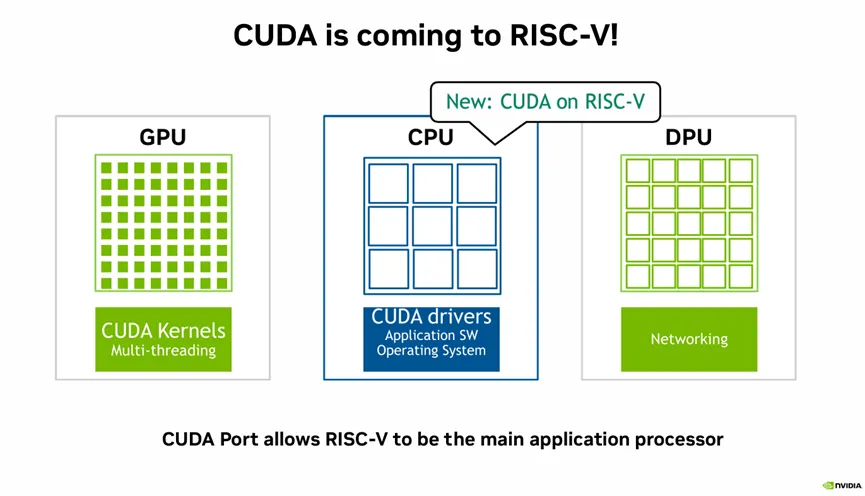
At the recent RISC-V China Summit, NVIDIA reportedly announced that CUDA will support the RISC-V instruction set architecture, according to an announcement shared by RISC-V International.
If implemented across the CUDA software stack, the move could expand NVIDIA’s GPU ecosystem beyond traditional x86 and Arm host processors and create new options for RISC-V-based AI systems.
The significance goes beyond simply recompiling CUDA for another CPU architecture. A complete RISC-V deployment would require changes across compilers, drivers, libraries, operating systems, and AI frameworks.
🧭 Breaking the x86 and Arm Dependency #
Since its introduction in 2006, CUDA has become a central component of NVIDIA’s GPU computing ecosystem. Most CUDA deployments have traditionally relied on x86 or Arm processors as the host architecture.
RISC-V introduces a fundamentally different option: an open instruction set architecture that allows chip designers to build customized CPU implementations without relying on proprietary ISA licensing.
If CUDA becomes broadly available on RISC-V, several changes could follow.
Technology Sovereignty #
RISC-V processors could act as host CPUs for NVIDIA GPU workloads without requiring x86 or Arm as the underlying architecture.
This could be particularly relevant to organizations developing vertically integrated computing platforms or seeking greater control over their processor designs.
Lower ISA Licensing Constraints #
RISC-V’s open ISA model removes traditional instruction-set licensing costs and restrictions. Chip designers can develop customized processors while retaining compatibility with the broader RISC-V software ecosystem.
The economic impact depends on implementation costs, software support, manufacturing, and the availability of competitive RISC-V CPU designs. An open ISA alone does not automatically make a complete processor platform inexpensive.
Architectural Flexibility #
RISC-V’s modular architecture allows processor designers to select and extend instruction-set features according to workload requirements.
For specialized AI servers, edge devices, and accelerators, this could enable CPU designs optimized specifically for GPU orchestration, networking, storage, or other system-level functions.
🧩 CUDA on RISC-V Requires More Than a Compiler Port #
Supporting RISC-V at the CUDA level would involve considerably more than recompiling application code.
A practical deployment would require coordination across multiple layers of the software stack.
CUDA Toolkit and Driver Stack #
The CUDA compiler, runtime, and supporting tools would need to operate correctly on RISC-V hosts.
NVIDIA’s driver stack would also need appropriate RISC-V support across its kernel-mode and user-mode components.
These layers provide the foundation required for applications to discover NVIDIA GPUs, allocate memory, launch kernels, and communicate with the hardware.
CUDA Libraries #
NVIDIA’s CUDA ecosystem contains a large collection of specialized libraries covering areas such as:
- Deep learning
- Scientific computing
- Linear algebra
- Signal processing
- Data analytics
- Inference
- Electronic design automation
Porting these components to RISC-V would be a substantial engineering effort.
The challenge is not limited to making binaries compile. Libraries must also be validated for ABI compatibility, performance, synchronization behavior, memory management, and interaction with the underlying driver stack.
AI Framework Integration #
Higher-level frameworks would also need RISC-V-compatible builds and testing.
Projects such as PyTorch depend on multiple layers of native code, compiler infrastructure, CUDA libraries, and third-party dependencies. Supporting RISC-V therefore requires coordination well beyond the CUDA runtime itself.
⚠️ Major Technical Challenges Remain #
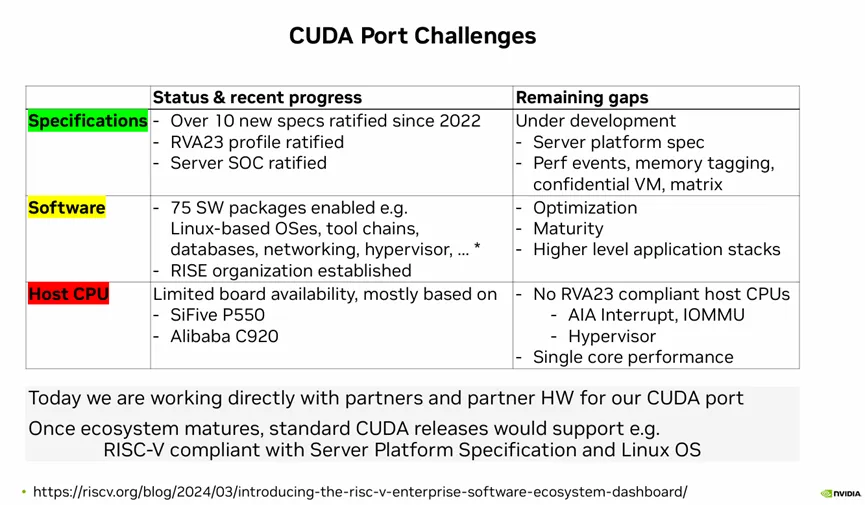
A RISC-V CUDA ecosystem would still face several hardware and software challenges before it could become a mainstream alternative to x86 or Arm.
Unified CPU-GPU Memory Management #
One important issue is Unified Virtual Memory (UVM) and the mechanisms required for efficient CPU-GPU memory sharing.
A mature heterogeneous-computing platform needs predictable virtual-memory behavior, address translation, synchronization, and page migration between CPU and GPU resources.
Differences in platform architecture can therefore require substantial operating-system, driver, and hardware support.
Server-Class RISC-V Hardware #
Software support also depends on suitable RISC-V processors and SoCs.
The availability of high-performance server-class RISC-V hardware is still an important constraint for large-scale GPU computing. Development boards can demonstrate architectural compatibility, but they do not necessarily provide the memory bandwidth, I/O, virtualization, reliability, and ecosystem support required by production AI servers.
The transition therefore depends on both CUDA software availability and the maturity of the RISC-V server hardware ecosystem.
🏗️ NVIDIA’s Broader Heterogeneous-Computing Strategy #
CUDA support for RISC-V also fits into a broader trend toward increasingly heterogeneous computing systems.
Modern data centers combine CPUs, GPUs, DPUs, networking hardware, storage accelerators, and other specialized processors. The host CPU remains important, but it is increasingly only one component of a larger accelerated platform.
Reducing Dependence on a Specific CPU ISA #
Supporting multiple CPU architectures gives NVIDIA greater flexibility at the platform level.
Instead of tying NVIDIA GPUs to a particular host architecture, a multi-ISA CUDA ecosystem could allow system builders to select x86, Arm, or RISC-V processors according to their requirements.
This potentially shifts more of the platform’s software value toward the GPU and CUDA ecosystem.
RISC-V and China’s Semiconductor Ecosystem #
RISC-V has attracted significant interest in China because its open ISA model can support domestic processor development without the same ISA licensing model associated with proprietary alternatives.
CUDA compatibility could therefore make NVIDIA GPUs easier to integrate into RISC-V-based systems if the necessary drivers, libraries, and frameworks become available.
However, CUDA support alone would not guarantee a complete domestic AI platform. Competitive processors, memory subsystems, operating systems, compilers, networking, manufacturing, and software compatibility would all remain necessary.
NVLink and Heterogeneous Systems #
NVIDIA’s broader platform strategy increasingly emphasizes tightly integrated heterogeneous systems.
Technologies such as NVLink and related interconnect architectures can connect GPUs with CPUs and other accelerators at high bandwidth.
In this model, a RISC-V CPU could become another host-processing option within a larger NVIDIA-centered system rather than replacing the GPU as the primary accelerator.
This aligns with the broader concept of treating the data center as an integrated computing system rather than a collection of independent CPU servers.
🔬 What CUDA Support Could Mean for RISC-V #
If the reported support develops into a complete production-ready ecosystem, the implications could extend across several markets.
| Area | Potential Impact |
|---|---|
| AI servers | RISC-V CPUs could host NVIDIA GPU accelerators |
| Edge computing | Custom RISC-V processors could be paired with NVIDIA GPUs |
| Research | More CPU architecture choices for heterogeneous computing |
| Semiconductor design | Greater freedom to customize host processors |
| China-based systems | Potential integration of RISC-V CPUs with CUDA-based platforms |
| Software ecosystem | Increased demand for RISC-V-compatible CUDA libraries and frameworks |
The actual impact will depend heavily on how broadly NVIDIA supports RISC-V and how quickly the surrounding hardware and software ecosystem matures.
🧠 Who Benefits From a RISC-V CUDA Ecosystem? #
The immediate technical beneficiaries would be system designers that want to combine NVIDIA GPUs with RISC-V processors.
For NVIDIA, broader host-architecture support could increase the number of platforms capable of integrating its accelerators.
For RISC-V developers, CUDA compatibility could provide access to a mature GPU-computing ecosystem that has historically been associated with x86 and, increasingly, Arm.
For system builders, the combination could create another option when designing specialized AI servers, edge systems, and heterogeneous computing platforms.
At the same time, significant engineering work remains between announcing architectural support and delivering a mature production ecosystem.
🏁 The Bigger Picture #
NVIDIA’s reported move toward RISC-V represents a potentially important shift in the relationship between CPU architectures and GPU computing.
CUDA has historically been strongly associated with x86 and Arm host systems. Adding RISC-V to that ecosystem could separate NVIDIA’s GPU software platform from dependence on a specific CPU instruction set.
The most important question is therefore not simply whether CUDA can run on RISC-V. The larger issue is whether the compiler, drivers, CUDA libraries, AI frameworks, operating systems, and server hardware can mature into a complete production stack.
If those pieces converge, RISC-V could become another host architecture for NVIDIA-accelerated computing, giving system designers more flexibility while further expanding the reach of the CUDA ecosystem.