Intel Arc Pro B70 Beats RTX 5090D in High-Concurrency AI Benchmark
The rapid adoption of large language models has shifted GPU purchasing decisions beyond gaming performance toward AI inference throughput, memory capacity, and deployment costs. While NVIDIA continues to dominate the AI accelerator ecosystem, new benchmark results suggest Intel is becoming a serious contender for enterprise inference workloads.
Recent testing published by graphics card manufacturer Gunnir shows the Intel Arc Pro B70 outperforming the NVIDIA RTX 5090D during high-concurrency FP16 inference using the DeepSeek R1 (Distill Qwen 32B FP16) model. Even more notable, Intel achieves this performance while costing roughly one-quarter as much as the competing RTX 5090D.
For organizations deploying local AI services, these results highlight an increasingly competitive market for professional inference hardware.
🚀 High-Concurrency AI Performance Takes Center Stage #
Unlike traditional GPU benchmarks that emphasize peak compute performance or gaming frame rates, this evaluation focused on one of the most important metrics for production AI services: sustained inference throughput under heavy concurrent workloads.
Test Configuration #
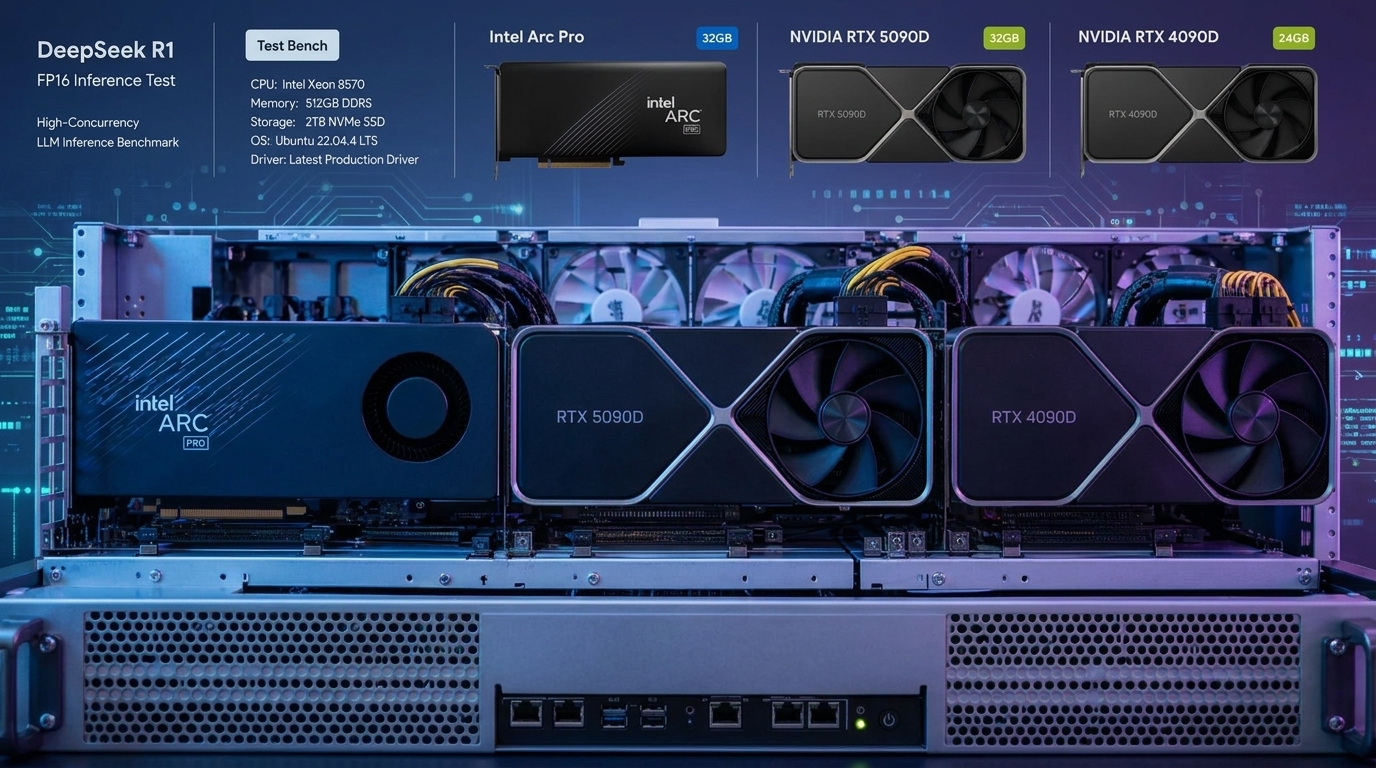
The benchmark compared three quad-GPU platforms:
- Intel Arc Pro B70 (32GB)
- NVIDIA RTX 5090D (32GB)
- NVIDIA RTX 4090D (24GB)
All systems executed inference using the DeepSeek R1 (Distill Qwen 32B FP16) model.
Testing parameters remained consistent across all platforms:
- Input length: 128 tokens
- Output length: 128 tokens
- Concurrency range: 1 to 512 simultaneous requests
The primary performance metric was tokens processed per second, measuring how efficiently each platform handled increasing inference demand.
📊 Benchmark Results Across Different Workloads #
Performance characteristics varied depending on concurrency level.
Low-Concurrency Performance #
At concurrency levels below 32 requests:
- RTX 5090D delivered the highest throughput.
- Intel Arc Pro B70 closely matched the RTX 4090D.
In lightly loaded environments, NVIDIA retained a small performance advantage.
Medium-Concurrency Performance #
Between 32 and 64 concurrent requests:
- Arc Pro B70 steadily closed the performance gap.
- Intel overtook the RTX 4090D.
This demonstrated stronger scalability as inference demand increased.
High-Concurrency Performance #
The most significant results appeared under heavy production-style workloads.

At 128 concurrent requests:
- Arc Pro B70 outperformed RTX 5090D by 8.6%.
- Arc Pro B70 exceeded RTX 4090D by 34.2%.
At 256 concurrent requests:
- Arc Pro B70 maintained a 7.5% lead over RTX 5090D.
- Performance exceeded RTX 4090D by 48.7%.
The performance advantage continued through the highest tested workload.
At 512 concurrent requests, Intel achieved a peak throughput of 2320.76 tokens per second.
These scenarios closely resemble enterprise inference services where hundreds of users simultaneously access a shared language model.
💰 Performance Per Dollar Changes the Equation #
Raw performance is only one part of GPU procurement.
Cost remains equally important for organizations deploying inference infrastructure at scale.
Current Pricing Comparison #
Approximate market pricing:
| GPU | Approximate Price |
|---|---|
| Intel Arc Pro B70 32GB | $999 |
| NVIDIA RTX 4090D 24GB | $2,000+ |
| NVIDIA RTX 5090D 32GB | $4,000+ |
Based on current pricing, the Arc Pro B70 costs roughly 25% as much as a single RTX 5090D.
For organizations deploying multiple inference servers, the difference in acquisition cost can significantly reduce total cost of ownership.
⚙️ Why Arc Pro B70 Performs Well Under Heavy AI Workloads #
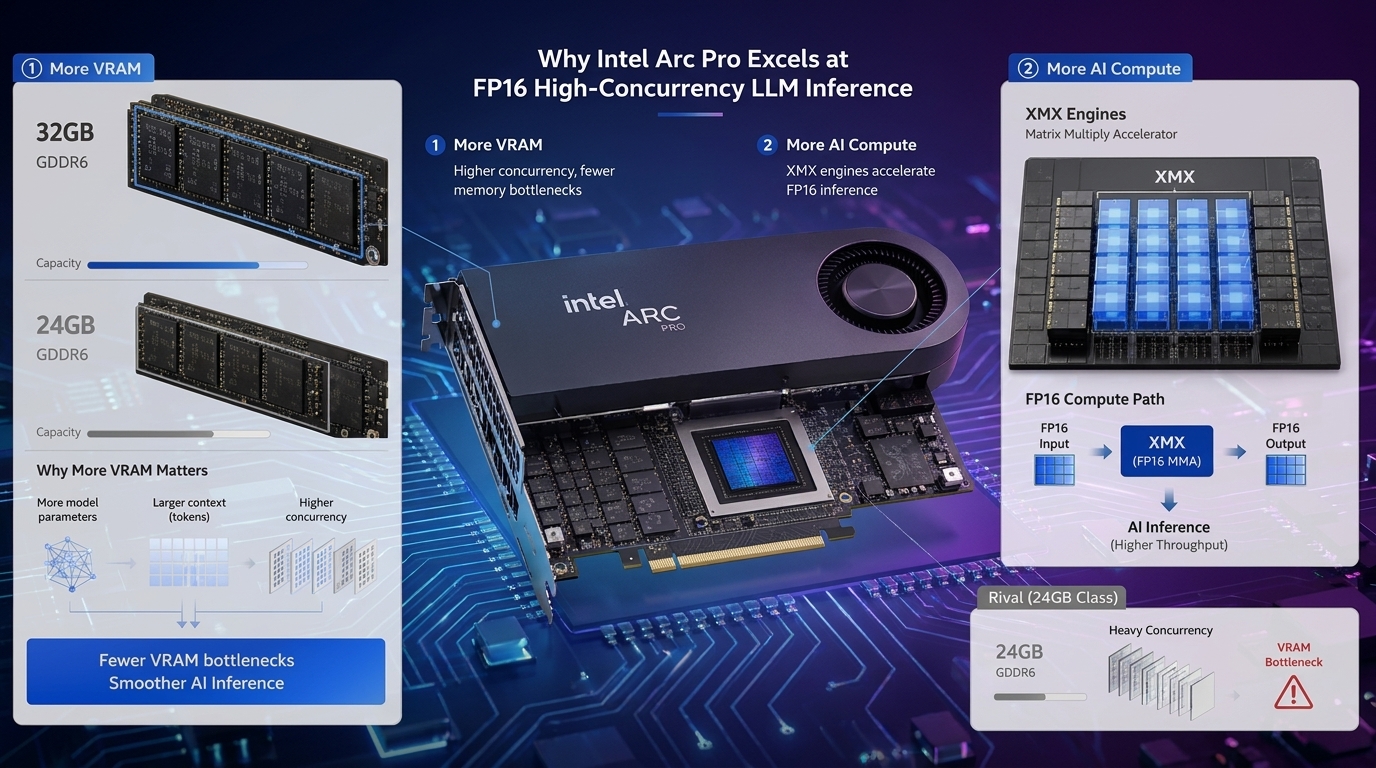
Two primary architectural characteristics help explain Intel’s strong performance in this benchmark.
32GB Memory Capacity #
The Arc Pro B70 includes 32GB of dedicated VRAM, providing a clear advantage over GPUs limited to 24GB.
Higher memory capacity enables:
- Larger model deployment.
- Longer context windows.
- Reduced memory pressure.
- Better scaling during multi-user inference.
As concurrency increases, memory capacity becomes increasingly important.
Dedicated XMX AI Acceleration #
Intel’s XMX Engines are specifically designed to accelerate matrix operations commonly used in AI inference.
For FP16 and INT8 workloads, these accelerators provide efficient execution of the mathematical operations required by transformer-based language models.
Because the benchmark uses native FP16 inference, the workload aligns well with Intel’s AI acceleration architecture.
📦 Changing GPU Availability May Influence Enterprise Deployments #
The benchmark also highlights an emerging market consideration beyond performance.
According to current supply chain information, NVIDIA’s original 32GB RTX 5090D is reportedly no longer being manufactured for the Chinese market.
Newer RTX 5090D V2 models are expected to ship with 24GB of memory, reducing available VRAM to the same capacity as the RTX 4090D.
For memory-intensive AI workloads, this reduction could further limit inference scalability under high concurrency.
Organizations planning long-term infrastructure deployments should therefore evaluate not only benchmark performance, but also future product availability and memory configurations.
🎯 FP16 Workloads Are the Key Context #
While the benchmark results are impressive, they should be interpreted within their intended workload.
The evaluation focused exclusively on:
- FP16 inference.
- DeepSeek R1 (Distill Qwen 32B).
- Large-scale concurrent request processing.
These results should not be generalized to every AI application.
NVIDIA’s Blackwell architecture introduces technologies such as NVFP4, which may deliver stronger performance for other precision formats or specialized AI workloads.
Performance characteristics will vary depending on:
- Model architecture.
- Numerical precision.
- Quantization strategy.
- Training versus inference.
- Framework optimization.
Organizations should evaluate hardware using benchmarks that closely match their intended production environment.
🏁 Intel Becomes a Stronger Competitor for Enterprise AI Inference #
The latest DeepSeek R1 benchmark demonstrates that Intel’s professional GPU lineup is becoming increasingly competitive in large language model deployment.
With:
- Peak throughput of 2320.76 tokens per second.
- Better scalability under heavy concurrent workloads.
- 32GB of dedicated memory.
- Dedicated XMX AI acceleration.
- A purchase price significantly below competing flagship GPUs.
The Intel Arc Pro B70 presents a compelling option for organizations prioritizing FP16 inference performance and deployment efficiency.
Although workload requirements will continue to determine the best hardware choice, these results suggest the enterprise AI GPU market is becoming more competitive, giving infrastructure planners meaningful alternatives beyond a single-vendor ecosystem.